2026-06-09 中国科学院(CAS)
<関連情報>
- https://english.cas.cn/newsroom/research-news/202606/t20260609_1161460.shtml
- https://iopscience.iop.org/article/10.3847/1538-4357/ae5529
シンクロトロン自己吸収スペクトルモデリングにより、ブレーザー1156+295における磁気駆動型ジェット内衝撃波シナリオが明らかになった Synchrotron Self-absorption Spectral Modeling Reveals a Magnetically Driven Shock-in-jet Scenario in Blazar 1156+295
Wancheng Xu, Lang Cui, Tao An, Sándor Frey, Xin Wang, Yuanqi Liu, Ning Chang, Liang Chen, and Yingkang Zhang
The Astrophysical Journal Published: 2026 April 24
DOI:10.3847/1538-4357/ae5529
Abstract
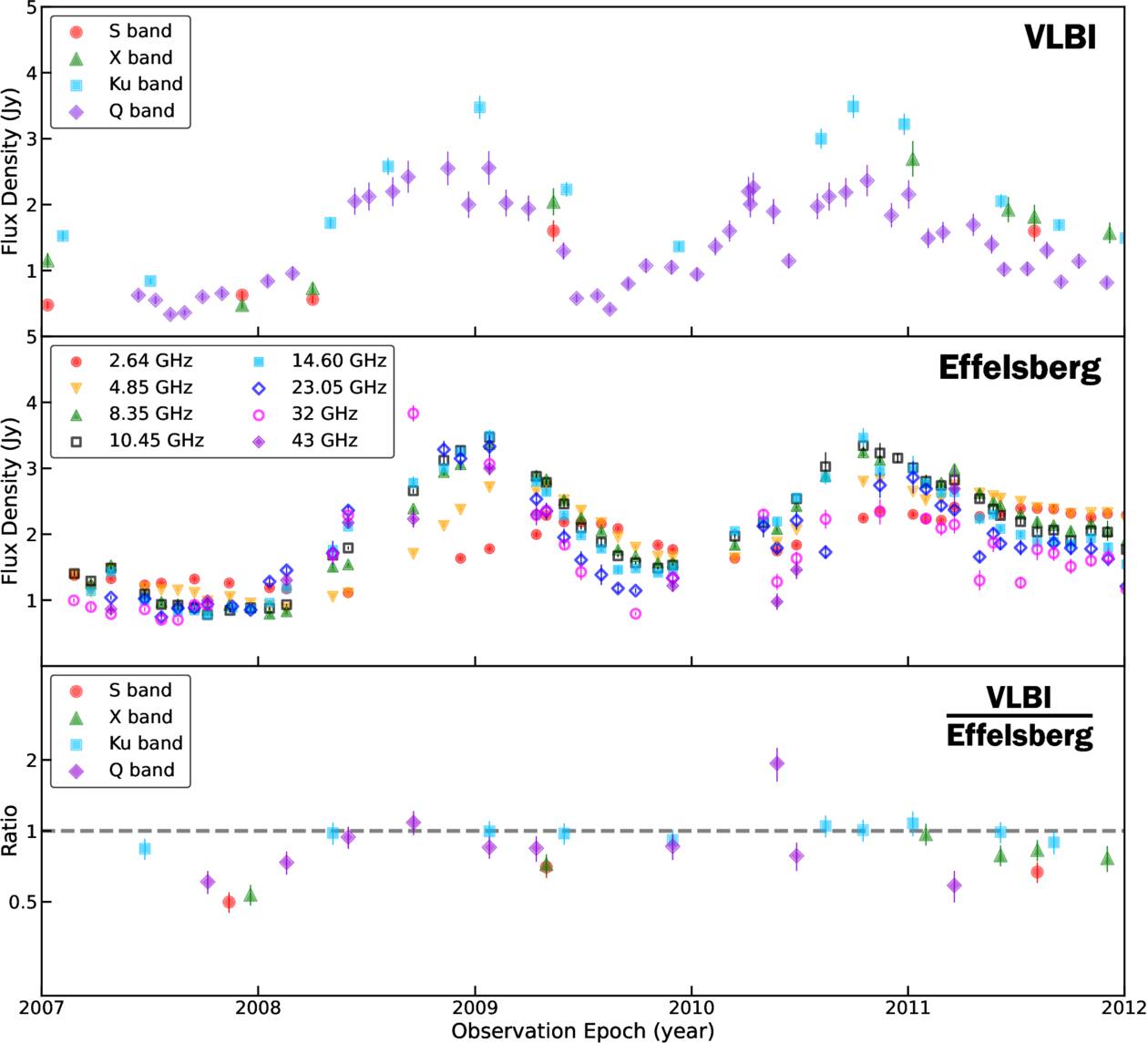
Unveiling the launching and driving mechanisms of powerful jets in active galactic nuclei is crucial for understanding the coevolution of supermassive black holes and their host galaxies. 1156+295 is a blazar at a redshift of z = 0.729 and exhibits significant variability in long-term radio monitoring. Using multifrequency Effelsberg single-dish flux density data from 2007 to 2012, we performed synchrotron self-absorption (SSA) spectral modeling and extracted the turnover frequency and turnover flux density. By combining SSA spectral modeling with the core size and brightness temperature from quasi-simultaneous very long baseline interferometry images, we estimated the jet magnetic field strength and magnetic flux and investigated their temporal evolution in 1156+295. The evolution of radio flux density, spectral shape, and jet structure is consistent with the shock-in-jet framework. The inferred magnetic flux reaching or exceeding the magnetically arrested disk threshold, together with evidence that magnetic energy release precedes the radio flares, supports a magnetically driven jet scenario. Overall, our results place magnetic field measurements, spectral evolution, and inner-jet structural changes on a common timeline, providing observational constraints on their coupled evolution during flares.