2026-06-09 中国科学院福建物質構造研究所(FJIRSM)
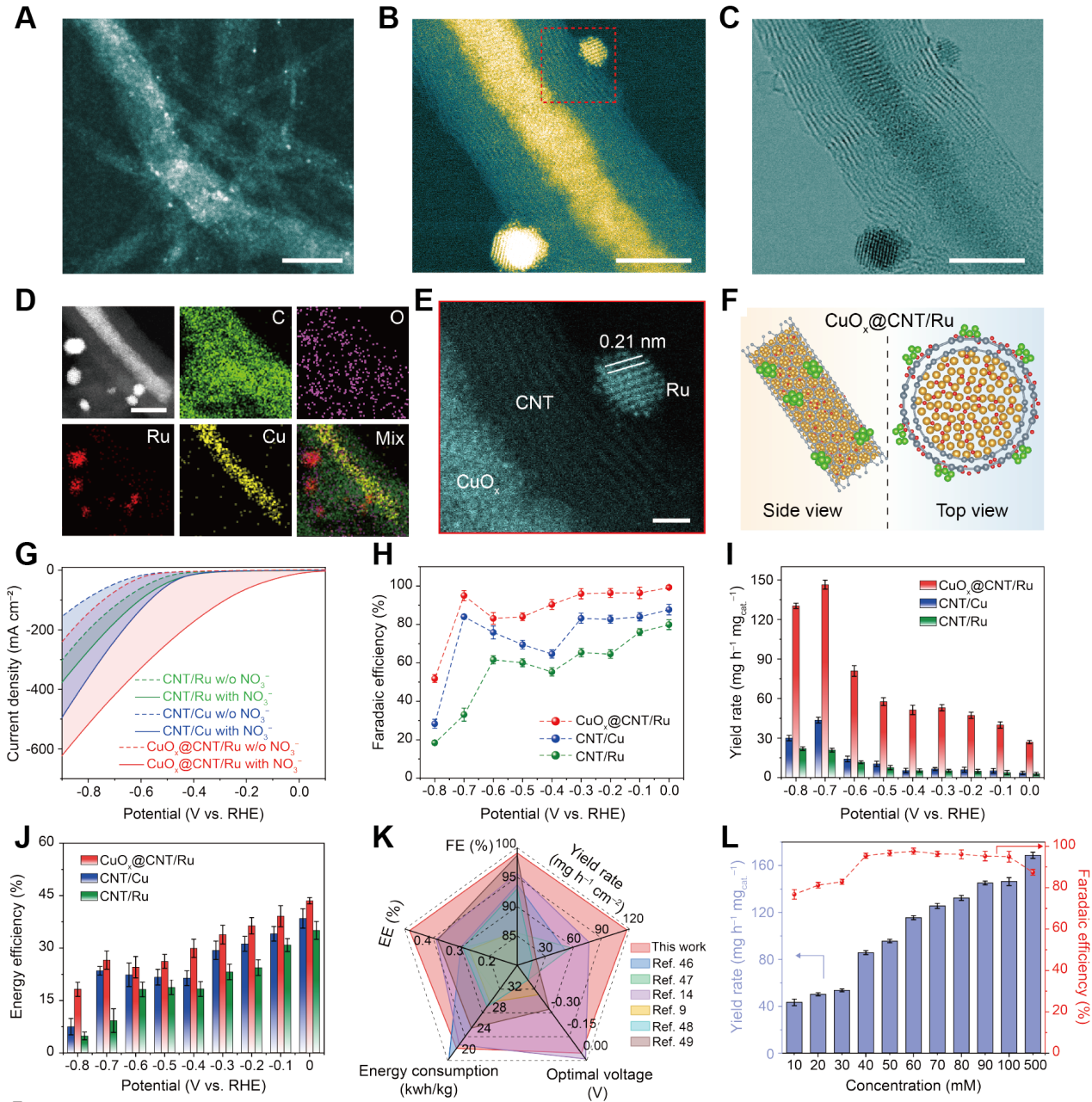
◆触媒は、カーボンナノチューブ(CNT)内部にアモルファス酸化銅(CuOx)ナノワイヤを閉じ込め、外表面に超微細ルテニウム(Ru)ナノ粒子を担持した“Inside-Out構造”を特徴とする。この構造により、CuOxとRuの強い電子的相互作用を維持しつつ活性部位を空間的に分離できる。アルカリ性電解液中での硝酸還元では、アンモニアのファラデー効率99.1%、エネルギー効率43.5%、最大生成速度146.37 mg h⁻¹ mgcat⁻¹を達成し、高い耐久性も示した。各種その場分光分析と第一原理計算により、Ruが硝酸吸着と水素化の主活性点として機能し、CuOxがRuを安定化するとともに硝酸活性化や水分解による活性水素供給を促進することが明らかとなった。さらに、この触媒をZn–NO3⁻電池の正極に適用したところ、開放電圧1.64V、最大出力密度22.6mW/cm²を示し、発電とアンモニア合成、硝酸除去を同時に実現した。
◆本研究は、持続可能なアンモニア製造技術と窒素循環利用の発展に貢献する成果である。
<関連情報>
- https://english.cas.cn/newsroom/research-news/202606/t20260609_1161402.shtml
- https://www.pnas.org/doi/10.1073/pnas.2537982123
効率的な硝酸塩のアンモニアへの電気化学的還元のための、内部から外部へと設計されたCuOx /Ruサイト Inside-out-engineered CuOx/Ru sites for efficient electrochemical nitrate reduction to ammonia
Dechao Chen, Yong Li, Zengxi Wei, +6 , and Lili Han
Proceedings of the National Academy of Sciences Published:May 13, 2026
DOI:https://doi.org/10.1073/pnas.2537982123
Significance
Electrochemical nitrate reduction offers a sustainable route for ammonia synthesis, but its progress is limited by competing side reactions and unclear active site dynamics. In this study, we propose an innovative inside-out catalyst architecture that integrates Ru nanoparticles with confined CuOx nanowires, demonstrating outstanding catalytic activity, selectivity, and energy efficiency. Notably, the catalyst also functions effectively as a cathode in a Zn−NO3 − battery. Combined experimental and theoretical insights reveal that CuOx stabilizes Ru active sites, facilitates the conversion of *NO3 to *NO2, and promotes hydrogenation of nitrogen intermediates, enabling efficient NO3 − -to-NH3 conversion. This work highlights a powerful strategy for engineering synergistic active site interactions in nitrogen electrosynthesis.
Abstract
Electrochemical nitrate reduction reaction (NO3−RR) provides a sustainable approach for both NO3− purification and NH3 production. Ru-based catalysts hold great promise for NO3−RR, but are limited by competing hydrogen evolution reaction, insufficient electrochemical stability, and the sluggish thermodynamics and kinetics of the initial *NO3 → *NO2 reduction step. Here, we develop an inside-out strategy by integrating ultrasmall Ru nanoparticles on the outer surface of carbon nanotubes and confined amorphous CuOx nanowires inside (CuOx@CNT/Ru) to enhance NH3 synthesis from NO3−RR. This catalyst achieves a leading NH3 yield rate of 146.37±3.4 mg h−1 mgcat−1 at −0.7 V vs. reversible hydrogen electrode (vs. RHE), a Faradaic efficiency of 99.1 ± 0.9% at 0 V vs. RHE, and the highest energy efficiency of 43.5 ± 0.9% at 0 V vs. RHE. Moreover, as a Zn−NO3− battery cathode, CuOx@CNT/Ru delivers a maximum power density of 22.6 mW cm−2 along with high NH3 production efficiency. In situ spectroscopic analysis and theoretical calculations reveal that Ru species serve as the main active centers, while high-valence CuOx not only stabilizes and activates Ru sites but also facilitates the conversion of *NO3 to *NO2 and promotes active hydrogen generation from water dissociation, thereby accelerating the hydrogenation kinetics of nitrogen-containing intermediates and reducing the energy barrier of the rate-determining step of *NO to *NOH, ultimately boosting NH3 synthesis. This work provides an efficient strategy for modulating active site interactions to promote sustainable nitrate reduction processes.