2026-06-05 東京理科大学,分子科学研究所,総合研究大学院大学,科学技術振興機構
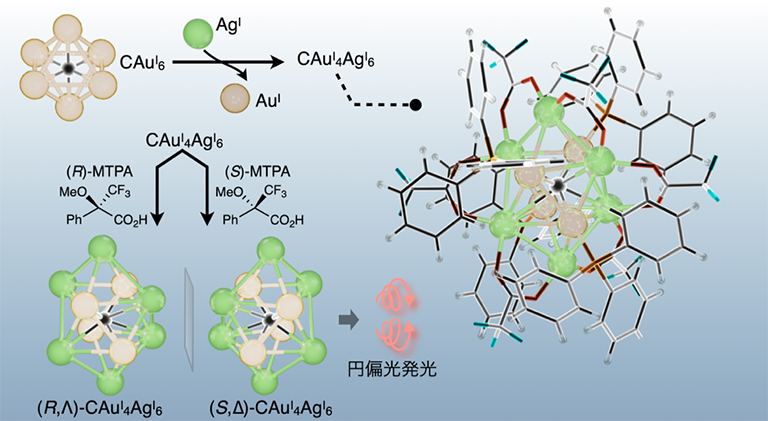
図1:銀(I)イオン導入および金(I)イオンのエッチングによる単原子レベルの不斉合金化
<関連情報>
- https://www.tus.ac.jp/today/archive/20260603_5791.html
- https://www.nature.com/articles/s41467-026-72787-w
赤色から近赤外のフォトルミネッセンスを示す、炭素原子にキラルなCAu I 4 Ag I 6多面体の異種金属イオンクラスターの非対称合金化 Asymmetric alloying for heterogeneous metal-ion clusters of chiral-at-carbon CAuI4AgI6 polyhedra exhibiting red to near-infrared photoluminescence
Xiao-Li Pei,Pei Zhao,Wen-Ting Liu,Hitoshi Ube,Zhen Lei,Masahiro Ehara & Mitsuhiko Shionoya
Nature Communications Published:05 June 2026
DOI:https://doi.org/10.1038/s41467-026-72787-w
Abstract
Well-defined subnano-sized metal clusters are highly susceptible to changes in the type, number and arrangement of the metals. Precise alloying and stereocontrol of metal clusters at the atomic level are therefore expected to elucidate unexplored structures and functions. Here, we report an asymmetric alloying method by adding silver trifluoroacetate to a highly symmetric C-centered hexagold(I) cluster protected by triphenylphosphine, and provide detailed descriptions of the structure and propertied of the resulting chiral-at-carbon hexasilver(I)-alloyed tetragoldmethane, CAuI4AgI6, in a bicapped square antiprism. Theoretical calculations reveal the bonding natures of C–AuI bonds and C···AgI interactions. By using homochiral carboxylate ligands, asymmetric induction to (R,Ʌ)- or (S,∆)-CAuI4AgI6 species is quantitatively achieved, each of which exhibits red to near-infrared phosphorescence and distinct chiroptical activity. This asymmetric silver(I)-alloying involves etching of gold(I) ions from the hexagold(I) cluster, which will further lead to the development of heterometal ion clusters as chiral luminescent materials.