20206-06-03 シカゴ大学(UChicago)
<関連情報>
- https://news.uchicago.edu/story/electrolytegpt-can-generate-new-formulations-battery-development
- https://pubs.acs.org/doi/10.1021/jacsau.5c01628
生成型電解質溶媒および製剤の発見 Generative Electrolyte Solvent and Formulation Discovery
Jaemin Kim,Ke-Hsin Wang,Ritesh Kumar,Peiyuan Ma,and Chibueze V. Amanchukwu
JACS Au Published: April 9, 2026
DOI:https://doi.org/10.1021/jacsau.5c01628
Abstract
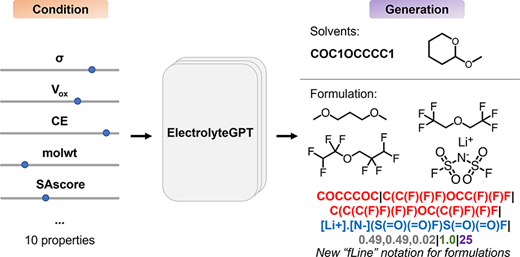
Molecular mixtures and/or formulations are of great importance in fields ranging from materials science to pharmaceuticals to chemistry. In batteries, electrolytes are complex molecular mixtures consisting of multiple salts and solvents and additives at different concentrations that dictate battery capacity, safety, and cycle life, among others. Unfortunately, due to the complex composition and infinite design space as well as the conflicting property requirements, electrolyte design is the rate-determining step in the design of next generation battery chemistries. In this work, we develop a transformer-based generative AI model – ElectrolyteGPT – capable of generating solvents and electrolyte formulations to satisfy a wide range of desired property requirements. First, we curate an electrolyte-relevant database and develop a new line notation for formulations. Then, we show that ElectrolyteGPT can generate solvents and formulations conditioned on a wide range of important electrolyte properties such as ionic conductivity, oxidative stability, Coulombic efficiency, viscosity, and more. Finally, we experimentally synthesize the generated solvents and fabricate the electrolyte formulations and show that they can meet the desired property requirements and enable long-term cycling in energy-dense anode-free lithium metal batteries. Our work showcases the ability of generative models to address challenges in molecular mixture design for next generation batteries.