2026-05-26 コロンビア大学
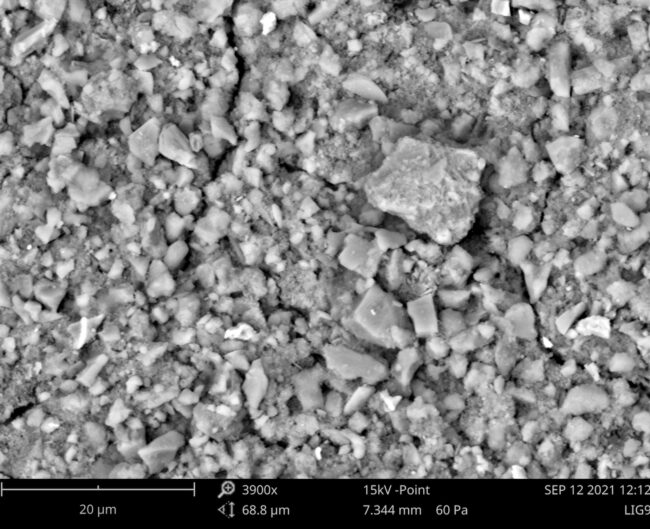
Mineral dust from a glacial period filtered out of an ice core and viewed using scanning electron microscopy. Photo: Austin Carter
<関連情報>
- https://news.climate.columbia.edu/2026/05/26/ancient-dust-points-to-retreat-of-west-antarctic-ice-sheet-during-last-warm-period/
- https://www.nature.com/articles/s41561-026-01988-1
最終間氷期の温暖化に伴うロス棚氷と西南極氷床の縮小 Diminished Ross Ice Shelf and West Antarctic Ice Sheet during Last Interglacial warming
Austin J. Carter,Sarah M. Aarons,Joseph C. Schnaubelt,Clay R. Tabor,John A. Higgins,Sarah A. Shackleton,Jenna A. Epifanio,Jacob D. Morgan,Janne M. Koornneef,Gareth R. Davies,Paolo Gabrielli,Alissa Choi,Jeffrey P. Severinghaus,Edward J. Brook,Douglas S. Introne,Julia C. Marks-Peterson,Johannes Sutter & Lindsey Davidge
Nature Geoscience Published:25 May 2026
DOI:https://doi.org/10.1038/s41561-026-01988-1
Abstract
The Last Interglacial, or Marine Isotope Stage (MIS) 5e (129–116 thousand years ago (ka)) was one of Earth’s most recent relatively warm intervals. Global mean sea levels are estimated to have been 5–10 m higher during MIS 5e than present; however, the potential contributors to higher sea levels during this interval, such as the loss of the West Antarctic Ice Sheet, remain poorly constrained. Here we present a high-resolution record of dust composition from an ice core at the Allan Hills Blue Ice Area, Antarctica spanning the Penultimate Glacial (MIS 6) through MIS 5e. Geochemical data show that MIS 6 dust is dominantly sourced from South America, whereas MIS 5e dust contains young volcanic material sourced from the McMurdo Sound sector of the West Antarctic Rift System and nearby, ice-free outcrops of the Transantarctic Mountains. Earth system model simulations show that loss of the Ross Ice Shelf and diminished West Antarctic Ice Sheet extent during MIS 5e would increase near-surface wind speeds and precipitation along an exposed Ross Sea coastline, strengthening dust transport from proximal Antarctic sources. The agreement between the modelled circulation changes and the observed provenance shift driven by changes in wind and surface exposure suggests ice-free conditions in the Ross Sea during MIS 5e, with possible West Antarctic contributions to the elevated sea levels of this period.