2026-05-28 ワシントン州立大学(WSU)
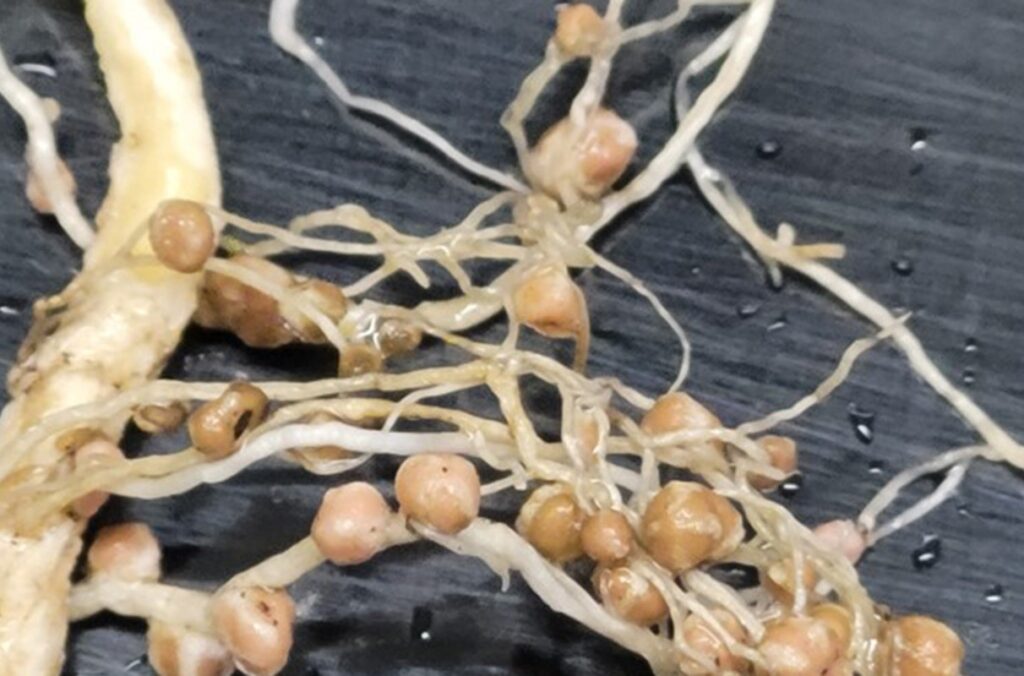
When rhizobia bacteria colonize plant cells, they trigger the development of pink nodules on their roots that maintain the right conditions for the bacteria to convert nitrogen from the air into a form usable to the plant, essentially fertilizing the plant. A new genetic technique developed by researchers at Washington State University enabled the conversion of bacteria that lacked any of the genes needed to trigger the formation of root nodules or nitrogen fixation into new rhizobia strains that can do both. (Photo by Stephanie Porter/WSU)
<関連情報>
- https://news.wsu.edu/press-release/2026/05/28/wsu-researchers-transfer-nitrogen-harvesting-genes-into-new-strains-of-bacteria/
- https://www.cell.com/current-biology/abstract/S0960-9822(26)00575-0
野生根粒菌における新規内共生の進化ゲノミクス The evolutionary genomics of novel endosymbiosis in wild rhizobia bacteria
Angeliqua P. Montoya ∙ Kyson T. Jensen ∙ Joel S. Griffitts ∙ Stephanie S. Porter
Current Biology Published:May 27, 2026
DOI:https://doi.org/10.1016/j.cub.2026.04.071
Highlights
- Mobile genetic element transfer generated novel nodule-forming bacteria endosymbionts
- Novel rhizobia symbionts were either commensal or N2-fixing mutualists with plants
- Phylogenetic relatedness limited symbiosis mobile element function but not transfer
- Symbiosis mobile elements were able to displace other genomic elements in replicons
Summary
The advent of endosymbiosis underlies evolutionary innovation and ecosystem function. However, whether free-living partners tend to benefit or exploit each other during the early stages of novel endosymbiosis remains a dilemma. Rhizobia soil bacteria can initiate root nodules and fix nitrogen for host plants as endosymbionts due to genes carried on mobile genetic elements such as the symbiosis island (SI). We conjugated marked SIs into the genomes of non-nodulating strains, which was sufficient to generate de novo root nodule-forming endosymbionts. Most novel endosymbionts originated as commensals that incurred no detectable costs to host plants, in contrast to predictions of exploitation. In fact, a third of novel endosymbionts originated as nitrogen-fixing mutualists. Consistent with phylogenetic limits to transfer of mobile genetic element function, novel endosymbionts derived from more closely related SI donor and recipient strains showed greater nitrogen fixation. However, consistent with selection on the SI for broad horizontal transfer, we did not detect phylogenetic limits to SI transmission, and the SI was able to displace other genomic elements residing at its characteristic tRNA gene insertion site. We thus provide genetic, genomic, and functional evidence of how mobile genetic elements can potentiate and constrain major evolutionary transitions to expand bacterial niches, with cascading impacts on the fitness of host organisms.