2026-05-26 中国科学院(CAS)
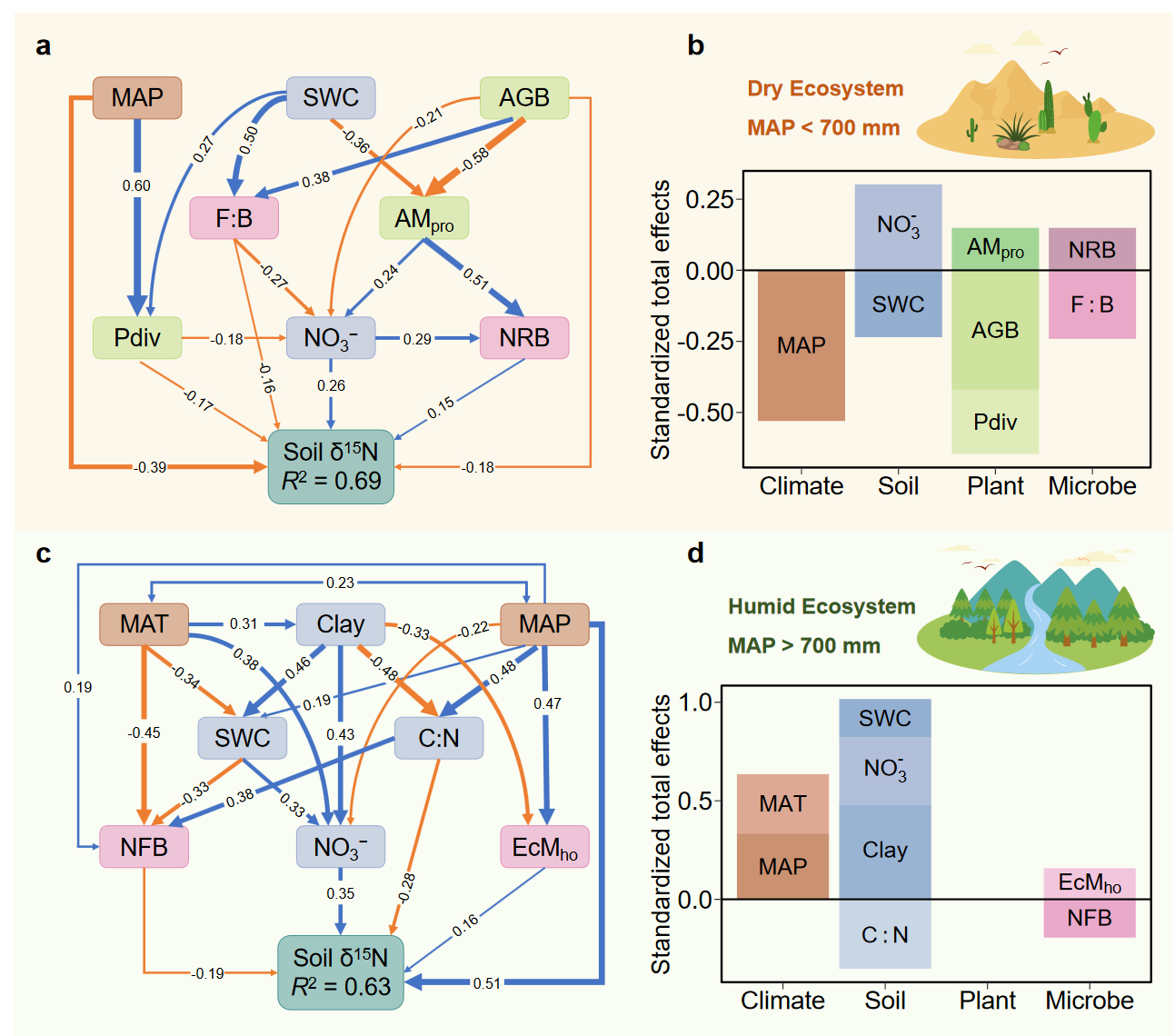
Contrasting controls of soil δ15N across precipitation regimes. (Image by PENG Yong)
<関連情報>
- https://english.cas.cn/newsroom/research-news/202605/t20260512_1159153.shtml
- https://www.nature.com/articles/s41561-026-01992-5
降水量の閾値によって引き起こされる、生態系の窒素保持における主要な制御因子の変化 Precipitation threshold-driven shifts in dominant controls of ecosystem nitrogen retention
Yong Peng,Jie Luo,Lulu Guo,Hongyi Chen,Yuxuan Gao,Ziyang Peng & Lingli Liu
Nature Geoscience Published:25 May 2026
DOI:https://doi.org/10.1038/s41561-026-01992-5
Abstract
Ecosystem nitrogen retention results from complex, long-term plant–soil–microbe interactions, yet integrating these processes across climatic gradient remains challenging. As a time-integrated tracer, the natural abundance of the stable nitrogen isotope (δ15N) in soil captures the cumulative balance of nitrogen inputs, transformations and losses, offering a robust proxy for ecosystem nitrogen retention. Although spatial patterns in δ15N have been widely documented, the drivers and their shifts across climatic thresholds remain unclear. Using data from 31 sites across the National Ecological Observatory Network in the United States, here we revealed that soil δ15N varies nonlinearly with mean annual precipitation, with a threshold (~700 mm) marking a shift in dominant controls. Below this threshold, soil δ15N decreased with precipitation and was shaped by plant community structure, microbial composition and soil nitrate concentration. Above the threshold, soil δ15N increased with precipitation, with soil physicochemical properties, particularly soil carbon/nitrogen ratio, nitrate concentration and clay content, exerting stronger influence. Precipitation thus regulates the ‘leakiness’ of the nitrogen cycle, shifting from rainfall-enhanced retention driven by plant–microbe competition in drier regions to rainfall-induced losses mediated by coupled hydrological and microbial transformations in wetter regions. These findings advance understanding of spatial variation in natural nitrogen cycling and provide a framework for predicting nitrogen dynamics under changing precipitation regimes.