2026-06-03 中国科学院(CAS)
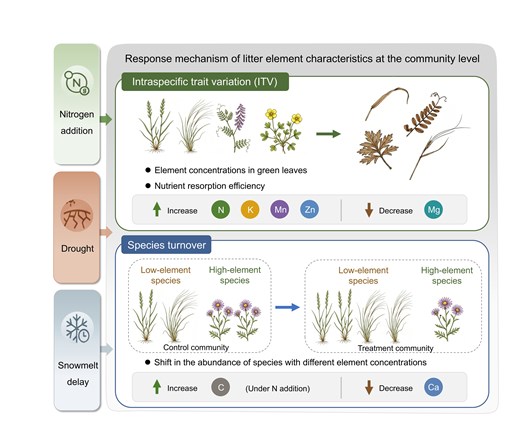
研究では、中国北部のエルグナ森林・草原移行帯生態系研究ステーションにおいて、窒素添加、融雪遅延、干ばつを単独または組み合わせて長期実験を実施した。炭素、窒素、リン、カリウム、カルシウム、マグネシウムに加え、マンガン、鉄、銅、亜鉛などの元素濃度を測定した結果、融雪遅延の影響は小さく、干ばつと窒素添加が主要な変動要因であることが判明した。干ばつや窒素添加により炭素、窒素、カリウム濃度は増加し、一方でカルシウムとマグネシウムは減少した。さらに、同一種内で環境変化に応じて形質が変化する「種内変異」が、窒素やカリウム、マンガン、亜鉛の増加およびマグネシウム減少の主因であった。対して、種構成の変化(種転換)はカルシウム減少に大きく関与し、一部ではマンガン濃度の変動を相殺する役割も果たした。
研究は、地球環境変化に対する草原生態系の養分循環応答を理解する上で、種内変異と種組成変化の双方を考慮する重要性を示している。
<関連情報>
- https://english.cas.cn/newsroom/research-news/202606/t20260603_1161064.shtml
- https://academic.oup.com/jpe/advance-article/doi/10.1093/jpe/rtag116/8694119
干ばつと窒素添加が温帯草原の落葉層の多元素特性を形成する Drought and nitrogen addition shape leaf litter multi-element characteristics in a temperate grassland
Xue Cui,Wang Ma,Shuang-Li Hou,Bing-Chuan Zhang,Jia-Xin Hu,Zheng-Wen Wang
Journal of Plant Ecology Published:\26 May 2026
DOI:https://doi.org/10.1093/jpe/rtag116
Graphical Abstract
Abstract
Litter plays a critical role in biogeochemical cycling, yet how its multi-element traits respond to concurrent global changes, such as extreme drought, nitrogen deposition and snowpack changes and their combinations, remains poorly understood. To address this gap, we established a multifactorial manipulative experiment in a temperate grassland, where drought, nitrogen deposition and snowmelt delay and all their combinations were simulated. We measured the concentrations of a suite of primary macronutrients (C, N, P, K), secondary macronutrients (Ca, Mg) and micronutrients (Mn, Fe, Cu, Zn) of plant litter. Afterwards, we examined the individual and combined effects of N addition, drought, and snowmelt delay on the concentrations of community-level litter elements, and quantified the relative contributions of intraspecific trait variation (ITV) and species turnover. The results showed that the element concentrations of leaf litter were primarily shaped by drought and N addition, with limited response to snowmelt delay. Community-level litter element responses were largely driven by ITV, which increased the concentrations of elements such as N, K, Mn, and Zn, and concurrently decreased the concentration of Mg. In contrast, species turnover was the dominant mechanism responsible for reducing litter Ca concentration under all conditions and for increasing litter C concentration under N addition, and it weakened the community-level response to environmental change by offsetting the ITV-driven increase in Mn. Our results demonstrate that ITV acts as the dominant mechanism, working in concert with species turnover to drive the responses of litter multi-element traits in the temperate grassland to multiple global change factors.