2026-07-23 中国科学院(CAS)
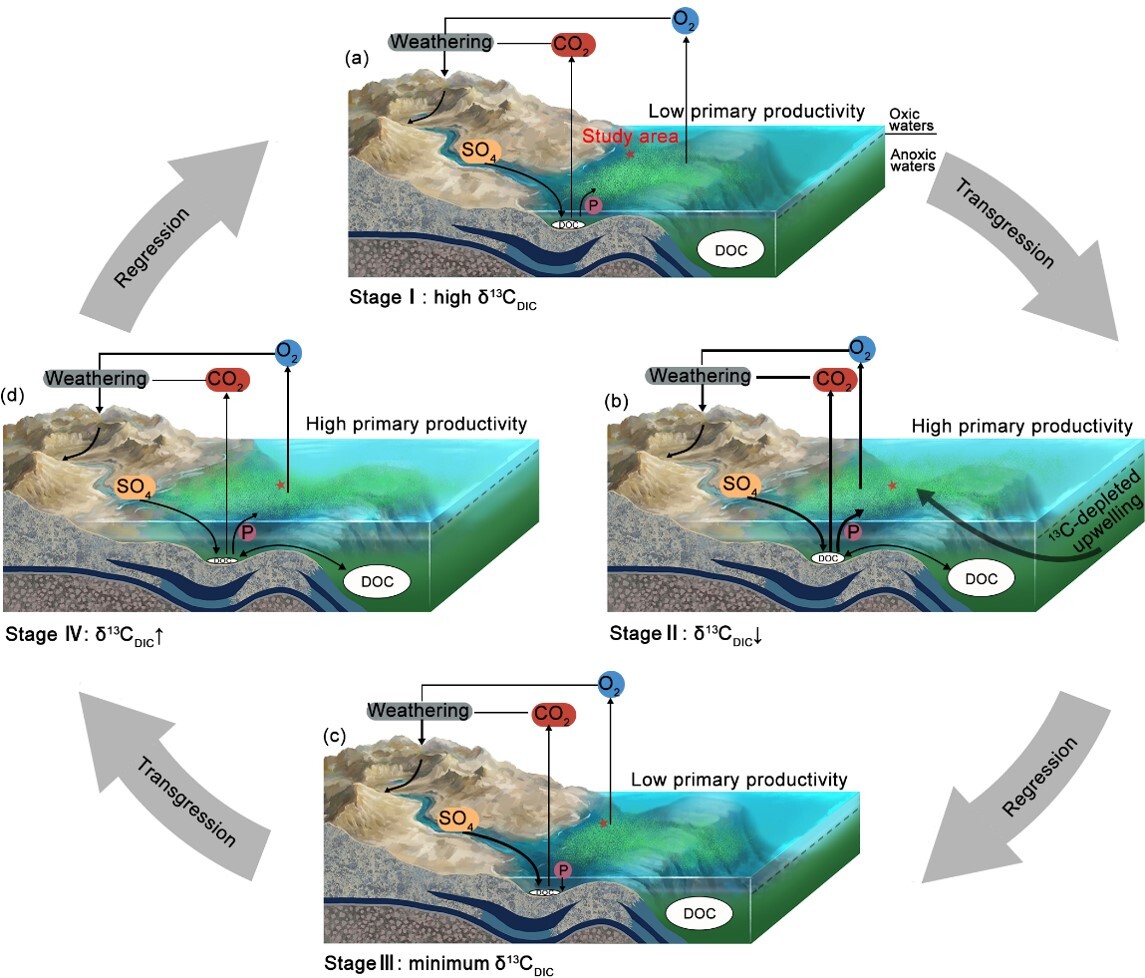
A 3D conceptual model for depicting the dynamics of the EN3/DOUNCE in South China, paced by the second-order sea-level oscillations. (Image by NIGPAS)
<関連情報>
- https://english.cas.cn/newsroom/research-news/202607/t20260723_1178949.shtml
- https://www.sciencedirect.com/science/article/abs/pii/S030192682600210X
エディアカラ紀の天文年代学は、シュラム変動の時間的不均一性と海面変動のペースを明らかにする Astrochronology of the Ediacaran Period reveals the temporal heterogeneity and sea-level pacing of Shuram excursion
Naihua Xue, Wei Wang, David De Vleeschouwer, Chengguo Guan, Mingsong Li, Meng Wang, Xunlai Yuan, Philippe Claeys
Precambrian Research Available online: 15 July 2026
DOI:https://doi.org/10.1016/j.precamres.2026.108222
Highlights
- A ~67-Myr astrochronology constrains the timing of carbon cycle perturbations and fossil assemblages of the Ediacaran Period.
- The astrochronological framework reveals temporal heterogeneity of the Shuram excursion.
- The Shuram excursion recorded in South China is paced by the second-order sea-level oscillations.
Abstract
The temporal framework of the Ediacaran Period remains fragmentary, thereby hindering progress in understanding the coevolution of ocean oxygenation and multicellular eukaryotes. This study presents Milanković cycles and carbon isotopic profile of the Doushantuo Formation of South China, establishing a continuous astrochronology from 635.1 ± 0.6 Ma to 568.3 ± 6.8 Ma. The most negative carbon isotope excursion, Shuram excursion of South China (EN3/DOUNCE), started no earlier than 584.2 ± 5.2 Ma and persisted for over 12.2 ± 1.4 Myr. Compared to the Shuram excursion recorded in open-ocean settings, the Shuram excursion of South China exhibits temporal heterogeneity in terms of potentially earlier onset, prolonged duration, and slower triggering, suggesting a heterogeneous pattern of global oceanic oxygenation. In addition, the prominent carbon cycle perturbations during the Shuram excursion in South China display sea-level paced oscillations. The newly established ∼67-Myr high-resolution astrochronology refines the current understanding of the evolutionary tempo and dynamics of Ediacaran macroscopic organisms and oceanic environment.