2026-05-21 京都大学
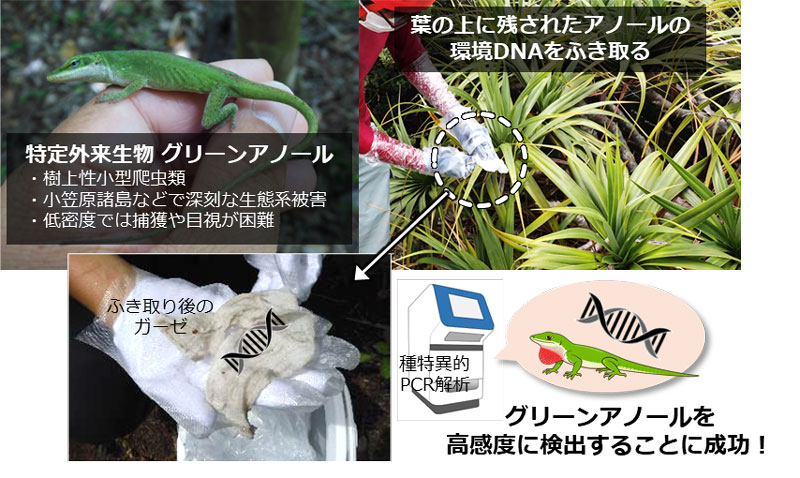
研究成果の概要。特定外来生物であるグリーンアノールの生息を、葉上に残された環境DNAを分析することで検知する手法の開発に成功した。(©辻冴月)
<関連情報>
- https://www.kyoto-u.ac.jp/ja/research-news/2026-05-21-2
- https://link.springer.com/article/10.1007/s10530-026-03797-4
樹上性の外来爬虫類を検出するための陸上環境 DNA サンプリング手法の開発:小笠原諸島のグリーンアノールにおける事例研究 Developing terrestrial environmental DNA sampling methods for detecting arboreal invasive reptiles: a case study of the green anole in the Ogasawara Island, Japan
Satsuki Tsuji,Yuki Murakami,Mitsuhiko Toda,Yosuke Yagami,Kou Ashizawa,Takuro Nishiwaki & Nayuta Yamamoto
Biological Invasions Published:21 March 2026
DOI:https://doi.org/10.1007/s10530-026-03797-4
Abstract
Early detection of invasive alien species is essential for preventing establishment and mitigating ecological impacts, particularly in island ecosystems harbouring evolutionarily isolated endemic species. Recently, despite increasing reptile introductions and their suggested widespread impacts, methods for monitoring arboreal invasive reptiles remain limited. This study addressed the need for practical detection tools by developing terrestrial environmental DNA (eDNA) sampling methods that collect DNA from leaf surfaces to detect the arboreal invasive green anole (Anolis carolinensis) in the Ogasawara Islands, Japan. Two methods, wiping leaf surfaces with gauze and rinsing with sprayed water, were tested. At an invaded site, green anoles were successfully detected in eight out of 10 samples in both methods. Although no significant difference in eDNA concentration was observed, the wiping method was selected for its greater simplicity. Subsequently, the relationship between green anole population density and eDNA concentrations detected using the wiping method showed a significant positive correlation, suggesting the potential of terrestrial eDNA to reflect arboreal reptile abundance for quantitative biodiversity assessments. Furthermore, the successful detection of eDNA even in the extremely low-density habitat of the green anole demonstrates the usefulness of eDNA-based surveys for early detection of invasions. The method developed here may be broadly applicable to terrestrial biodiversity monitoring, especially in tree-dwelling taxa. Given accelerating biological invasions and biodiversity loss, this approach is expected to benefit managers, conservationists, and researchers concerned with terrestrial ecosystems.