2026-07-17 ノースカロライナ州立大学(NC State)
<関連情報>
- https://news.ncsu.edu/2026/07/backyard-mosquito-sprays-may-be-fueling-insecticide-resistance/
- https://royalsocietypublishing.org/rsos/article/13/7/251678/482487/Socioeconomic-predictors-of-knockdown-resistance
- https://link.springer.com/article/10.1186/s13071-026-07519-6
世界的に侵入しているヒトスジシマカ(Aedes albopictus)におけるノックダウン耐性の社会経済的予測因子 Socioeconomic predictors of knockdown resistance in the globally invasive tiger mosquito Aedes albopictus
Cole D. Butler;Jessica Y. Ding;Jennifer Baltzegar;Zachary S. Brown;Martha O. Burford Reiskind;Michael H. Reiskind
Royal Society Open Science Published:08 Jul 2026
DOI:https://doi.org/10.1098/rsos.251678
Abstract
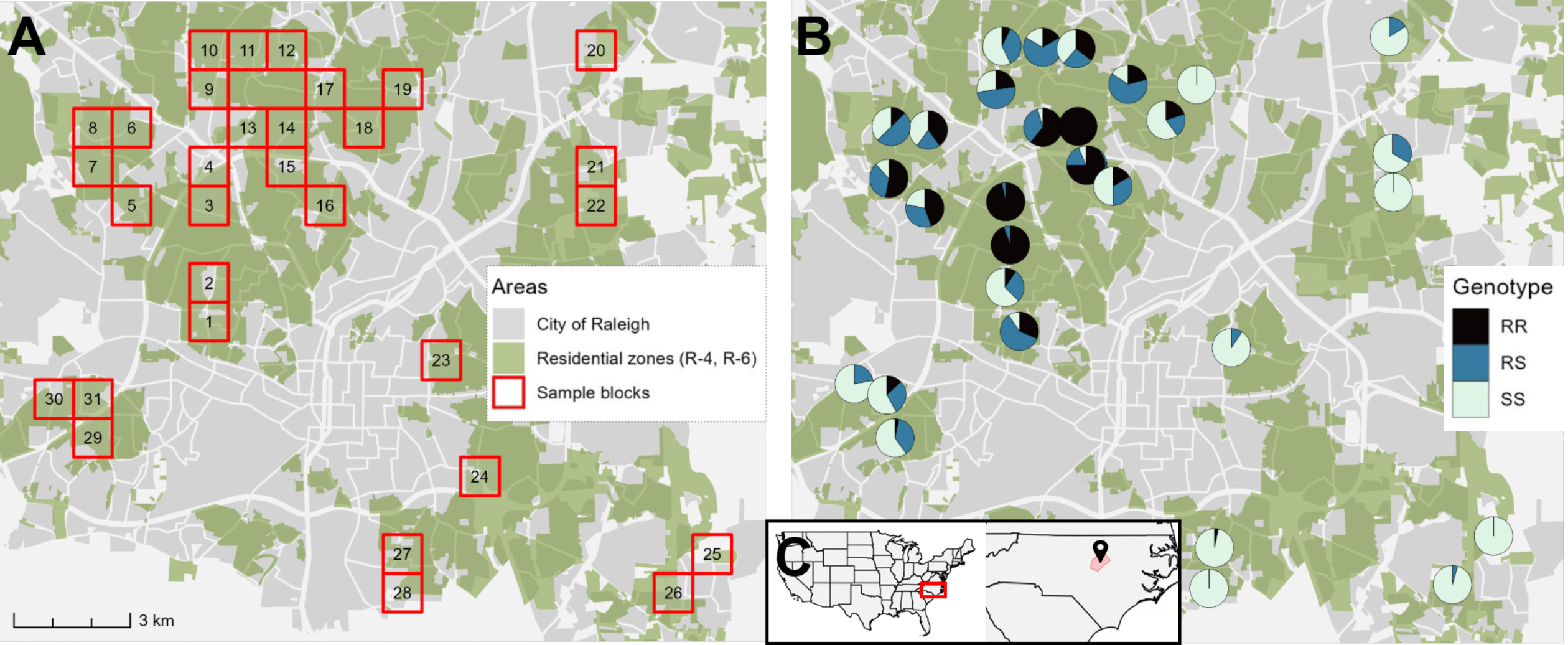
The tiger mosquito Aedes albopictus (Skuse) is a nuisance biter and vector for many dangerous pathogens. Population control of this species primarily relies on the spraying of chemical insecticides. However, the emergence of insecticide resistance, otherwise known as knockdown resistance (kdr), jeopardizes control and is a serious threat to public health. Effectively managing resistance requires us first to understand the conditions that predict its evolution. Here, we investigate the association between total property value (TPV) and the frequency of kdr in Ae. albopictus populations in Raleigh, North Carolina, USA. We hypothesized that kdr frequency correlates with TPV, because we speculate that wealthier neighbourhoods apply chemical insecticides more frequently. We tested this hypothesis by sampling mosquito populations from 31 different residential blocks across the city and along a TPV gradient. Overall, we found a high frequency of kdr (39%) over a spatially heterogeneous distribution that was significantly correlated with TPV. We find evidence supporting a connection between socioeconomic factors and the rise of insecticide resistance, something not previously documented for this species. This suggests that economic interventions may be a promising approach to resistance management in this and other contexts.
郊外に生息するヒトスジシマカにおけるノックダウン耐性の出現と空間分布 Emergence and spatial distribution of knockdown resistance in a suburban population of Aedes albopictus
Jennifer F. Baltzegar,Cole D. Butler,Jessica Y. Ding,Chay M. Beeson,E. M. X. Reed,Michael H. Reiskind & Martha O. Burford Reiskind
Parasites & Vectors Published:27 June 2026
DOI:https://doi.org/10.1186/s13071-026-07519-6 Unedited version
Abstract
Background
Aedes albopictus is a major vector of arboviral diseases and is often targeted by pyrethroid-based mosquito control in residential areas. While knockdown resistance (kdr) mutations are well-documented in Ae. aegypti, their emergence in Ae. albopictus has been less studied, particularly in suburban environments, where insecticide application is often uncoordinated. Understanding the temporal and spatial dynamics of resistance evolution in this context is critical for preserving the effectiveness of public health interventions.
Methods
We conducted longitudinal sampling of Ae. albopictus populations in Wake County, North Carolina, from 2016 to 2024. Using a novel allele-specific PCR melt curve assay, we genotyped 2,669 mosquitoes at the F1534S locus in the voltage-gated sodium channel gene. Resistance allele frequencies were calculated annually and mapped across the county for three key years, representing the pre-emergence (2016), initial detection (2018), and widespread phases of resistance development (2023). Selection and dominance were estimated using the Wright–Fisher approximate Bayesian computation algorithm for locus F1534S.
Results
The F1534S resistance allele was first detected in 2018 at a central neighborhood in Wake County. By 2023, the allele had become distributed throughout the sampling region, with the highest observed frequencies near the site of first detection. Resistance allele frequency peaked at 0.36 in 2023, accompanied by an increase in heterozygous and homozygous resistance genotypes. Temporally sampled sites showed consistent trends in rising frequencies of the resistance allele, with all temporally sampled locations harboring resistance genotypes by 2022. The resistance allele was estimated to have a high selection coefficient and to be partially recessive in this population.
Conclusions
Our findings reveal rapid emergence and spatial distribution of the F1534S kdr allele in a suburban population of Ae. albopictus. The observed distribution of resistance alleles is consistent with strong genetic selection. These results highlight the need for proactive resistance monitoring and integrated management strategies that address private-sector contributions to insecticide selection pressure.