2026-05-21 東北大学
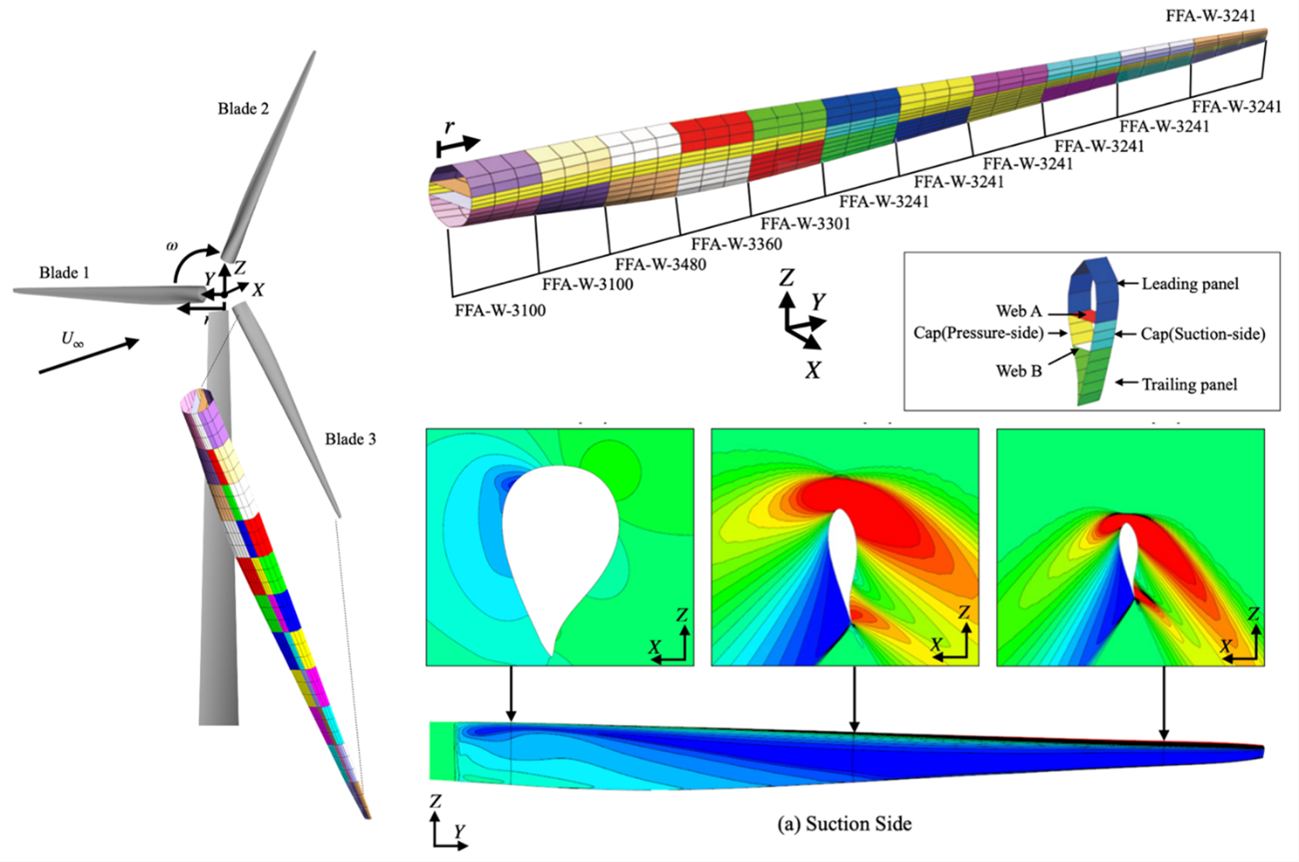
図1. 10MW級大型風力発電ブレードの構造モデルと空力解析結果
<関連情報>
- https://www.tohoku.ac.jp/japanese/2026/05/press20260521-01-framework.html
- https://www.sciencedirect.com/science/article/pii/S0141029626007996
複合材風力タービンブレードの設計における繊維特性の影響に関するマルチスケール数値解析フレームワーク Multi-scale numerical framework for effects of fiber properties on designing composite wind turbine blades
Tomoki Yamazaki, Yoshiaki Abe, Ryosuke Kano, Shugo Date, Tomonaga Okabe
Engineering Structures Available online: 19 May 2026
DOI:https://doi.org/10.1016/j.engstruct.2026.122885
Highlights
- Multiscale framework bridges micro-failure and structural sizing for wind turbine.
- FSI analysis by RANS for rotating blades was performed with structural sizing.
- Matrix-dominant failure occurs in GFRP; shear buckling governs thinner CFRP blades.
- High-stiffness T1100G CFRP achieved a 56.6% weight reduction compared to GFRP.
Abstract
This study presents a multi-scale numerical framework accounting for microscopic failure phenomena for the aero-structural design of a 10MW offshore wind turbine with 90 m-span blades that are made of glass-fiber or carbon-fiber reinforced plastics: GFRP (Silenka E-Glass 1200tex®) or CFRP (Torayca T700S®, T800S®, or T1100G®). Using static aeroelastic analysis combined with structural sizing and failure analysis, the structural thickness of spar caps, leading and trailing panels, and webs were estimated. Starting with the evaluation of aerodynamic force by computational fluid dynamics, the structural thickness was then updated in an iterative manner until the margin of safety for all failure modes, including matrix-dominant failure and shear/compression buckling, satisfied the requirements. The results showed that the matrix-dominant failure was observed only in the GFRP model, whereas shear buckling was more prevalent in the CFRP models. Owing to matrix-dominant failure, the leading panel of the GFRP model had the greatest thickness among all the models. Additionally, it was shown that using stiffer fiber in the CFRP materials decreases the thickness of the components, and the T1100G model exhibited the lightest structure among all the models. This study is the first attempt to quantitatively assess the impact of the material characteristics of carbon-fiber on their application in the blade structure of a 10MW-class offshore wind turbine. The proposed aero-structural design framework improves the efficiency of the digital design of wind turbine blades.