2026-07-03 中国科学院華南植物園(SCBG)
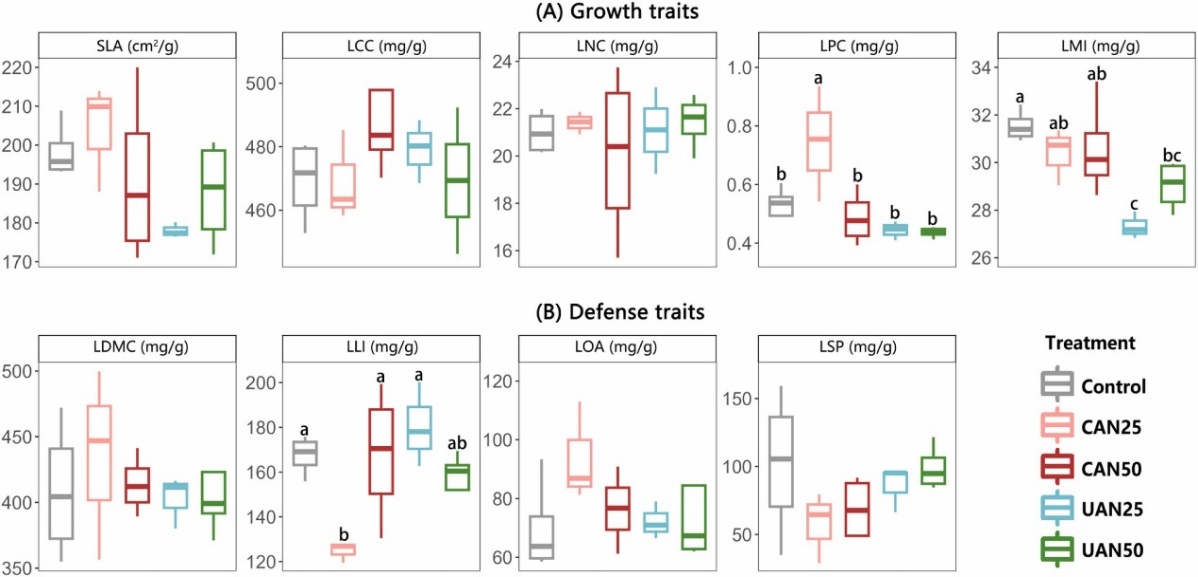
Fig 1. Effects of N addition on overall community trait values of low understory community.(Image by LIU Nan)
<関連情報>
- http://english.scib.cas.cn/news/202607/t20260703_1176213.html
- https://www.sciencedirect.com/science/article/abs/pii/S0378112726005372
窒素沈着をシミュレーションした際の林床植物の反応における種内形質変異の役割 The role of intraspecific trait variation in understory responses to simulated nitrogen deposition
Lingbo Ji, Songbo Tang, Jing Long, Siyu Liu, Nan Liu, Shuguang Jian, Bo Tang, Liping Wei, Hai Ren
Forest Ecology and Management Available online: 20 June 2026
DOI:https://doi.org/10.1016/j.foreco.2026.124039
Highlights
- Long-term N addition effects on intra- and interspecific trait variation.
- High-understory community traits remained stable under N addition.
- Low-understory growth and defence traits can vary with N addition.
- Intraspecific variation was important in explaining low-understory trait variation.
- Several trait variations correlated with understory biomass production.
Abstract
Atmospheric nitrogen (N) deposition is a well-documented driver of functional trait shifts in forest ecosystems, yet the community-level implications of trait variation and its linkage to productivity remain poorly understood. We investigated the effects of eight years of canopy and understory N additions (CAN and UAN) on understory plant community traits (growth and defense traits) in terms of both intraspecific and interspecific variation, and their relationship with biomass production in an evergreen broad-leaved forest of South China. Here, traits and biomass were studied in high- and low-understory layers at a threshold of 2 m in height. We surveyed vegetation, measured nine key leaf traits for 18 dominant and common species, and estimated the biomass production. N addition had no significant effect on community-weighted mean (CWM) traits of the high-understory. In the low-understory, however, the CWM of two growth traits – leaf phosphorus (LPC) and mineral (LMI) concentrations – respectively increased under CAN and decreased under UAN, while a defense trait, leaf lignin concentration (LLI), decreased under UAN. Moreover, we detected a generally high intraspecific trait variation contribution in the low-understory, particularly LMI and LLI. Several traits – including specific leaf area, LPC and LLI – showed significant relationships with understory biomass production. Our results suggest that evergreen broad-leaved forests can buffer some impacts of chronic N deposition on understory communities. However, we still detected evidence of changes from the perspective of intraspecific trait variation and its relationships with biomass production in the low-understory community. We highlight the critical importance of intraspecific trait variation as a key metric for long-term monitoring of forest community responses to global change, revealing ecological adjustments that may underpin or compromise understory stability.