2026-07-03 中国科学院華南植物園(SCBG)
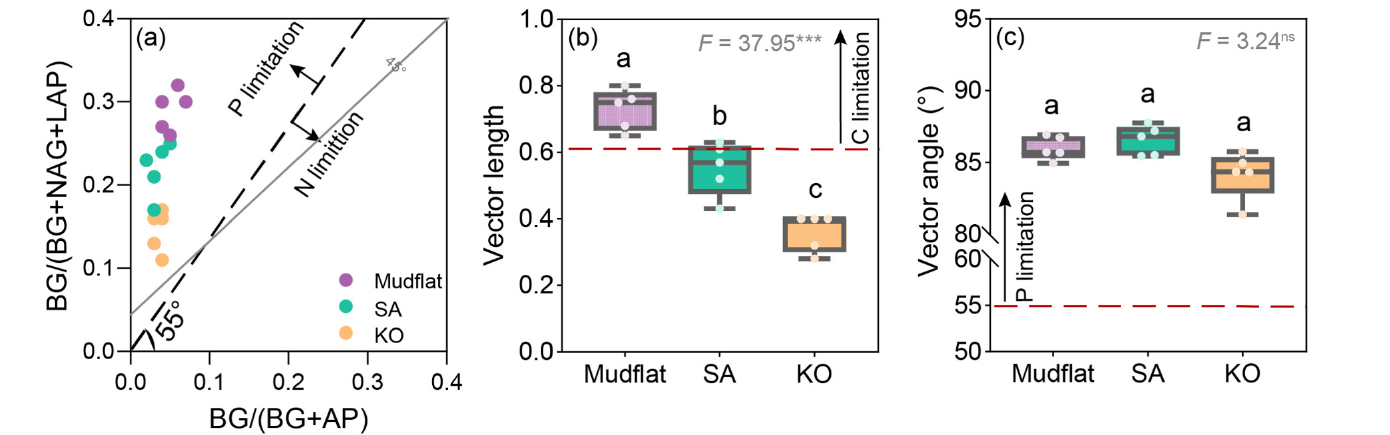
Figure 1. Mangrove restoration markedly relieved microbial carbon limitation, whereas phosphorus limitation persisted across degraded and restored sites.(Image by WANG Faming)
<関連情報>
- http://english.scib.cas.cn/news/202607/t20260703_1175610.html
- https://www.sciencedirect.com/science/article/abs/pii/S0341816226005060
微生物による炭素制限がマングローブ再生中のブルーカーボンの質を左右する Microbial carbon limitation shapes blue carbon quality during mangrove restoration
Xingyun Huang, Cantong Huang, Wensui Li, Fangyuan Guan, Guoming Qin, Zhe Lu, Jingwei Shi, Jingfan Zhang, Jinge Zhou, Ruyi Ding, Hui Li, Shamim Ahmed, Peter I. Macreadie, Faming Wang
Catena Available online: 16 June 2026
DOI:https://doi.org/10.1016/j.catena.2026.110296
Highlights
- Mangrove restoration alleviated microbial carbon limitation by enhancing organic matter quantity and quality.
- Soil nutrient availability, rather than microbial community demand, dominate microbial carbon limitation.
- Restoration promotes plant-derived carbon but reduces the contribution of microbial-derived carbon.
- Restoration creates a trade-off between soil organic carbon accumulation and quality.
Abstract
Mangrove restoration significantly enhances blue carbon sequestration by increasing soil organic carbon (SOC) storage, but the microbial constraints governing SOC turnover and source composition remain poorly understood. Here, we investigated microbial carbon (C) and nutrient limitations across degraded and restored mangrove soils, and explored their relationships with plant- and microbial-derived SOC using lignin phenols and amino sugars as biomarkers. Our results showed that degraded mudflat soils were co-limited by C and phosphorus (P), while restoration alleviated microbial C limitation through enhanced litter and root-derived organic matter inputs and improved organic C quality – despite shifts toward more nutrient-demanding microbial life-history strategies. Nutrient availability, rather than microbial community demand, emerged as the dominant control on microbial C limitation. Microbial C limitation was negatively correlated with SOC-standardized lignin phenols (explaining 65% of the variation) and positively with amino sugars (58%), suggesting that restoration increases SOC quantity while altering its source composition by promoting the accumulation of plant-derived SOC and reducing the relative contribution of microbially-derived SOC. These findings identify microbial C limitation as a key gatekeeper of blue carbon outcomes, influencing not only the magnitude of C storage but also the sources and quality of restored blue carbon pools.