2026-05-18 ジョージア工科大学
<関連情報>
- https://ece.gatech.edu/news/2026/06/georgia-tech-researchers-discover-new-form-nand-flash-data-storage-deep-space-missions
- https://pubs.acs.org/doi/10.1021/acs.nanolett.5c05947
積層型強誘電体スタックを利用した固体NANDストレージの耐放射線性向上 Enabling Radiation Hardness in Solid-State NAND Storage Utilizing a Laminated Ferroelectric Stack
Lance Fernandes,Stuart Wodzro,Prasanna Venkatesan,Priyankka Ravikumar,Ming-Yen Lee,Minji Shon,Dyutimoy Chakraborty,Taeyoung Song,Sanghyun Kang,Salma Soliman,Mengkun Tian,Jason Yeager,Jackson Adler,Jiayi Chen,Zekai Wang,Douglas Wolfe,Shimeng Yu,Andrea Padovani,Suman Datta,Biswajit Ray,and Asif Khan
Nano Letters Published: March 5, 2026
DOI:https://doi.org/10.1021/acs.nanolett.5c05947
Abstract
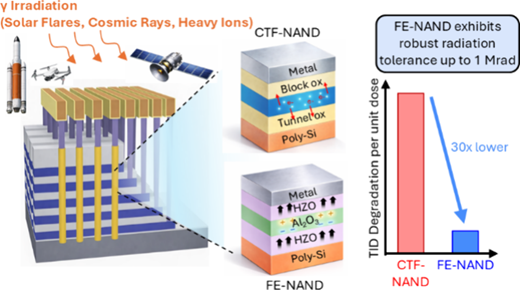
NAND flash forms the core of modern solid-state storage, which is critical for data-intensive AI applications, yet charge-trap NAND suffers rapid threshold-voltage (Vth) degradation under ionizing radiation, causing reliability challenges for space and defense applications. Here we show that ferroelectric field-effect transistors (FeFETs) with laminated gate stacks offer a promising route to achieving radiation resilience in vertical NAND technology. We demonstrate that large-memory-window, vertical NAND-compatible laminated poly-silicon-channel FeFETs with an 8 nm Hf0.5Zr0.5O2/3 nm Al2O3/8 nm Hf0.5Zr0.5O2 stack retain a full memory window and robust switching up to 10 Mrad(air) of the total ionizing dose (TID). Programmed and erased states show negligible TID-induced drift after 1 Mrad(air), while only the erased state degrades by ∼2 V at 10 Mrad(air). Technology computer-aided design (TCAD) modeling attributes these asymmetric shifts to state-dependent traps. Compared to charge-trap NAND, laminated FeFETs exhibit ∼30-fold lower Vth degradation per unit dose, positioning them as superior radiation-resilient storage candidates.