
2026-05-14 イェール大学
<関連情報>
- https://news.yale.edu/2026/05/14/it-time-expand-our-thinking-about-dark-matter-new-study-says-yes
- https://iopscience.iop.org/article/10.3847/2041-8213/ae53ea
マルチスケール銀河団レンズ効果により、新たな冷たい暗黒物質危機が明らかに New Cold Dark Matter Crisis Revealed by Multiscale Cluster Lensing
Priyamvada Natarajan, Barry T. Chiang, and Isaque Dutra
The Astrophysical Journal Letters Published: 2026 April 8
DOI:10.3847/2041-8213/ae53ea
Abstract
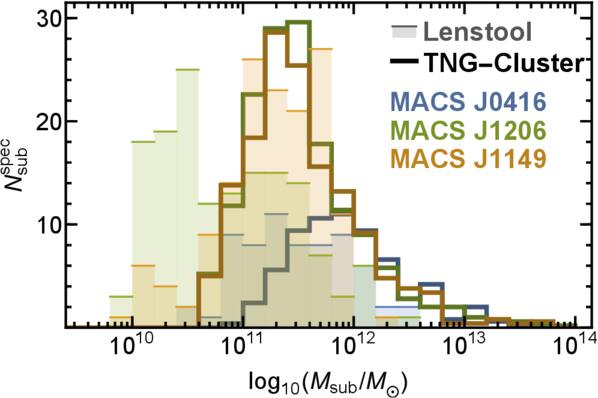
The properties of substructure in galaxy clusters, exquisitely probed by gravitational lensing, offer a stringent test of dark matter (DM) models. Combining strong- and weak-lensing data for massive clusters, we map their total mass—dominated by DM—over the dynamic range needed to confront small-scale predictions for collisionless cold DM (CDM). Using state-of-the-art lens models, we extract four key subhalo properties: the mass function, projected radial distribution, internal density profile, and tidal truncation radius. We find that the subhalo mass functions and truncation radii are consistent with CDM expectations. In contrast, the inner density profiles and radial distributions of subhalos are strongly discrepant with CDM. The incidence of galaxy–galaxy strong lensing from subhalo cores exceeds CDM predictions by nearly an order of magnitude, requiring inner density slopes as steep as γ ≳ 2.5 within r ≲ 0.01 R200 consistent with core-collapsed self-interacting DM (SIDM), while the same subhalos behave as collisionless in their outskirts. Additionally, the observed radial distribution of subhalos hosting bright cluster member galaxies, explicitly modeled in the lens reconstructions, remains incompatible with CDM. Taken together, these small-scale stress tests reveal an intriguing paradox and challenge the DM microphysics of purely collisionless CDM, motivating hybrid scenarios—such as a dual-component model with both CDM and SIDM or entirely new classes of DM theories.

