2026-05-13 東北大学
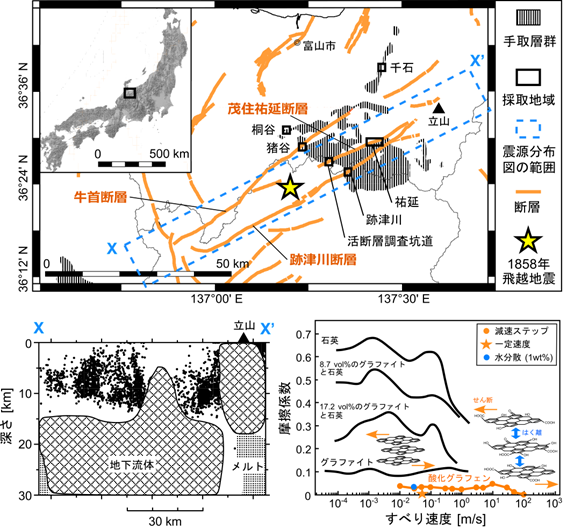
図1. (上)跡津川断層系の地質図。(左下)跡津川断層系に沿った地震の震源分布図。(右下)石英、グラファイト、酸化グラフェンの摩擦係数の比較。
<関連情報>
- https://www.tohoku.ac.jp/japanese/2026/05/press20260513-02-graphene.html
- https://www.nature.com/articles/s41467-026-72239-5
跡津川断層系における超低摩擦グラフェン酸化物 Ultra-low friction graphene oxide in the Atotsugawa Fault System
Tomoya Shimada (島田知弥),Hiroyuki Nagahama (長濱裕幸),Jun Muto (武藤潤),Norihiro Nakamura (中村教博),Sando Sawa (澤燦道) & Hiroaki Ohfuji (大藤弘明)
Nature Communications Published:12 May 2026
DOI:https://doi.org/10.1038/s41467-026-72239-5
Abstract
The active Atotsugawa Fault System in central Japan exhibits low levels of seismicity and creep to depths of 7–8 km. Low-friction graphite (friction coefficient, μ ~ 0.1) in fault rocks has previously been proposed as a mechanism for reducing fault strength and contributing to aseismic creep. Here, we use state-of-the-art Raman spectroscopy, X-ray photoelectron spectroscopy (XPS) and transmission electron microscopy (TEM) to document for the first time the discovery of graphene oxide in natural fault gouge, a material characterized by an ultra-low coefficient of friction (μ ~ 0.01) and possible superlubricity. Graphene oxide is concentrated within microcracks in fault gouge and occurs as single-layer sheets with particle sizes of 3–10 nm. Analysis of hydroxyl groups and the degree of oxidation indicate that the graphene oxide has the most effective chemical composition for fault weakening. We suggest that graphene oxide in fault rocks could dramatically reduce fault frictional strength and promote fault creep.