2026-05-01 東北大学
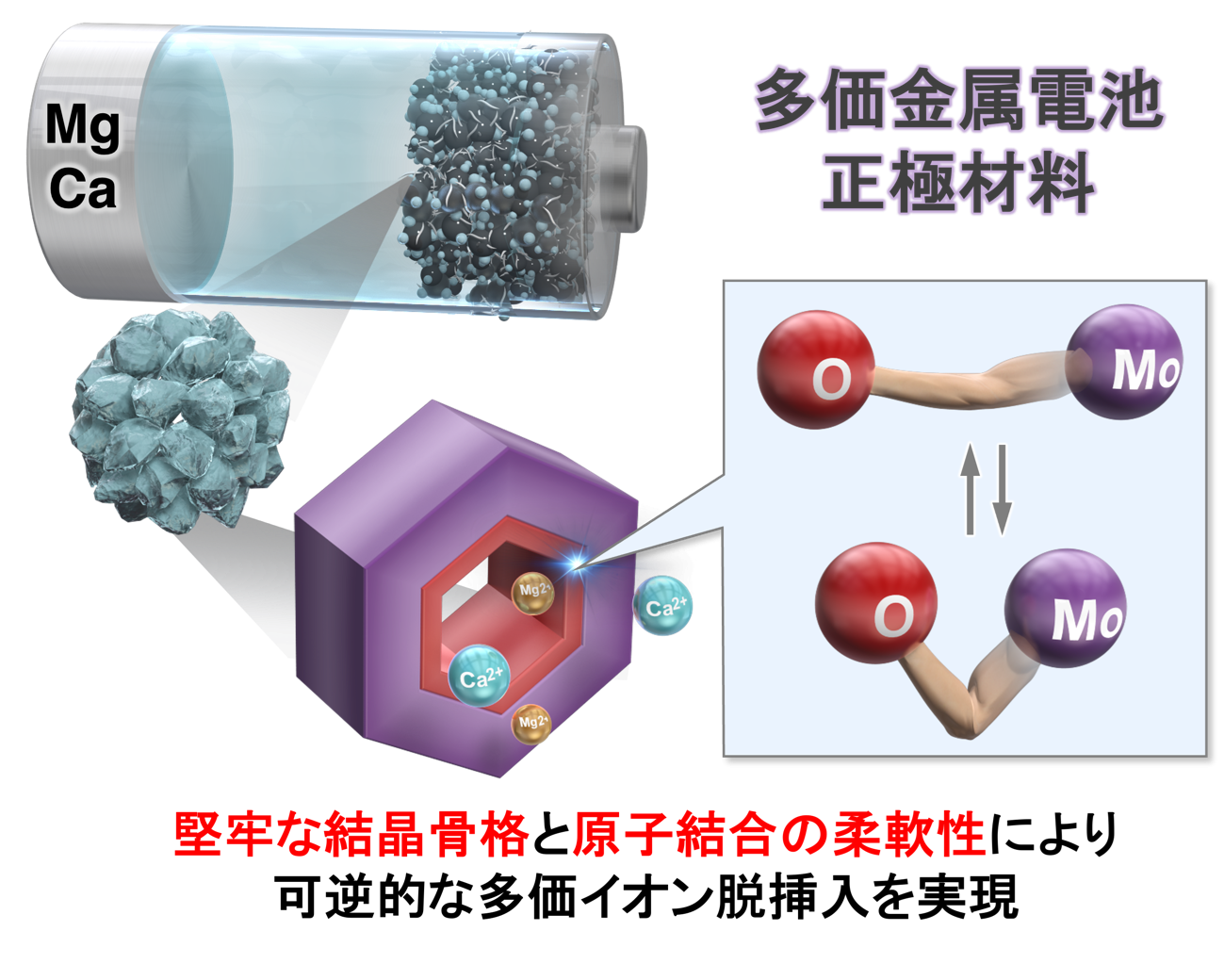
図1. トンネル構造型酸化モリブデン正極で進行する多価金属電池反応の模式図
<関連情報>
- https://www.tohoku.ac.jp/japanese/2026/05/press20260501-04-ion.html
- https://advanced.onlinelibrary.wiley.com/doi/10.1002/aenm.71006
トンネル構造のMoO₃正極を用いた超低歪みカルシウム・マグネシウムイオン貯蔵 Ultra-Low-Strain Calcium and Magnesium Ion Storage Enabled by Tunnel-Structured MoO3 Positive Electrode
Reona Iimura, M. D. Hashan C. Peiris, Takashi Yabu, Toshihiko Mandai, Ruijie Zhu, Akira Nasu, Saneyuki Ohno, Masaki Matsui, Itaru Honma, Manuel Smeu, Hiroaki Kobayashi
Advanced Energy Materials Published: 28 April 2026
DOI:https://doi.org/10.1002/aenm.71006
ABSTRACT
Rechargeable divalent batteries employing Ca or Mg metal negative electrodes have attracted considerable interest due to their low cost and potentially high energy density. However, the development of high-energy Ca and Mg batteries remains limited by the lack of oxide positive electrodes capable of reversibly accommodating divalent ions at room temperature. Here, we demonstrate a new positive electrode material, a nano-sized hexagonal tunnel-structured MoO3 (nano-h-MoO3), as a structurally robust host for both Ca2+ and Mg2+ storage, exhibiting markedly improved reversibility and capacities. Comprehensive structural analyses, supported by computational modeling, reveal a unique charge–discharge mechanism in which divalent-ion (de)insertion occurs through reversible modulation of host metal–oxygen bond lengths while retaining an intact host framework, resulting in minimal lattice expansion (<2%). This structurally resilient tunnel-oxide design provides a promising pathway for developing high-energy, practical divalent metal battery systems.