2026-04-27 ハーバード大学
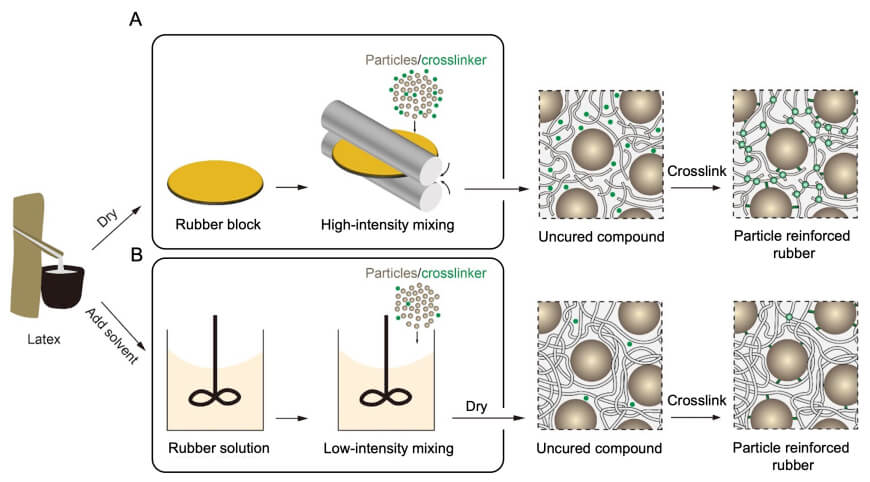
Silica-reinforced natural rubber processed in two routes, with and without mastication. A conventional route begins by mixing dry rubber, silica particles, and additives by high-intensity processes, which masticate polymer chains. A new solution-based process begins with dissolving latex particles into rubber chains in toluene. The solution is mixed with silica particles by low-intensity mixing, which retains long chains.
<関連情報>
- https://seas.harvard.edu/news/toward-tougher-longer-lasting-more-sustainable-tires
- https://www.pnas.org/doi/10.1073/pnas.2530834123
シリカ強化天然ゴムの靭性を、長鎖構造を維持することによって向上させる Amplifying toughness in silica-reinforced natural rubber by preserving long chains
Matthew Wei Ming Tan, Guodong Nian, Zheqi Chen, +2 , and Zhigang Suo
Proceedings of the National Academy of Sciences Published:March 23, 2026
DOI:https://doi.org/10.1073/pnas.2530834123
Significance
Natural rubber is the most widely used bioelastomer, valued for its high crack resistance arising from long rubber chains and strain-induced crystallization (SIC). However, this advantage is not fully realized in silica-reinforced natural rubber, limiting its use for high-performance tires. Conventional processing shortens rubber chains to ease mixing but reduces performance. Here, we uniformly mix silica particles and natural rubber chains—without chain scission. With long chains and sparse crosslinks, the rubber strands readily align under stretch, amplifying SIC. The resulting material achieves a combination of high stiffness and toughness seldom observed in silica-reinforced rubbers. The strategy opens doors to silica-reinforced rubber for high-severity applications.
Abstract
Natural rubber outperforms synthetic rubbers because of its long chains and strain-induced crystallization (SIC). However, these advantages are largely lost when the natural rubber chains are masticated during processing, and silica particles are added for reinforcement. Mastication eases mixing but shortens chains and lowers performance. Silica particles require covalent interlinks with rubber chains, but these interlinks restrict chain stretch and alignment, reducing SIC. Here, we show that the performance of silica-reinforced natural rubber can be markedly enhanced by preserving long natural rubber chains. We use a solvent to dissolve natural rubber latex into individual rubber chains and use the solution to uniformly disperse silica particles. After drying, the uncured compound can be stored and molded prior to curing. The long rubber chains are then sparsely crosslinked with one another and interlinked with the silica particles. The long strands readily align under stretch and increase SIC. Preserving long chains elevates toughness by an order of magnitude, from ~2 to 44 kJ m–2. High toughness arises from energy dissipation across multiple length scales, over long rubber strands, silica particles, and a zone of SIC. High modulus of ~19 MPa arises from two interpenetrating networks: the network of densely entangled rubber chains and the network of percolated silica particles. The resulting material achieves high toughness while maintaining high modulus, a combination uncommon in silica-reinforced synthetic and natural rubbers.