2026-04-23 東北大学
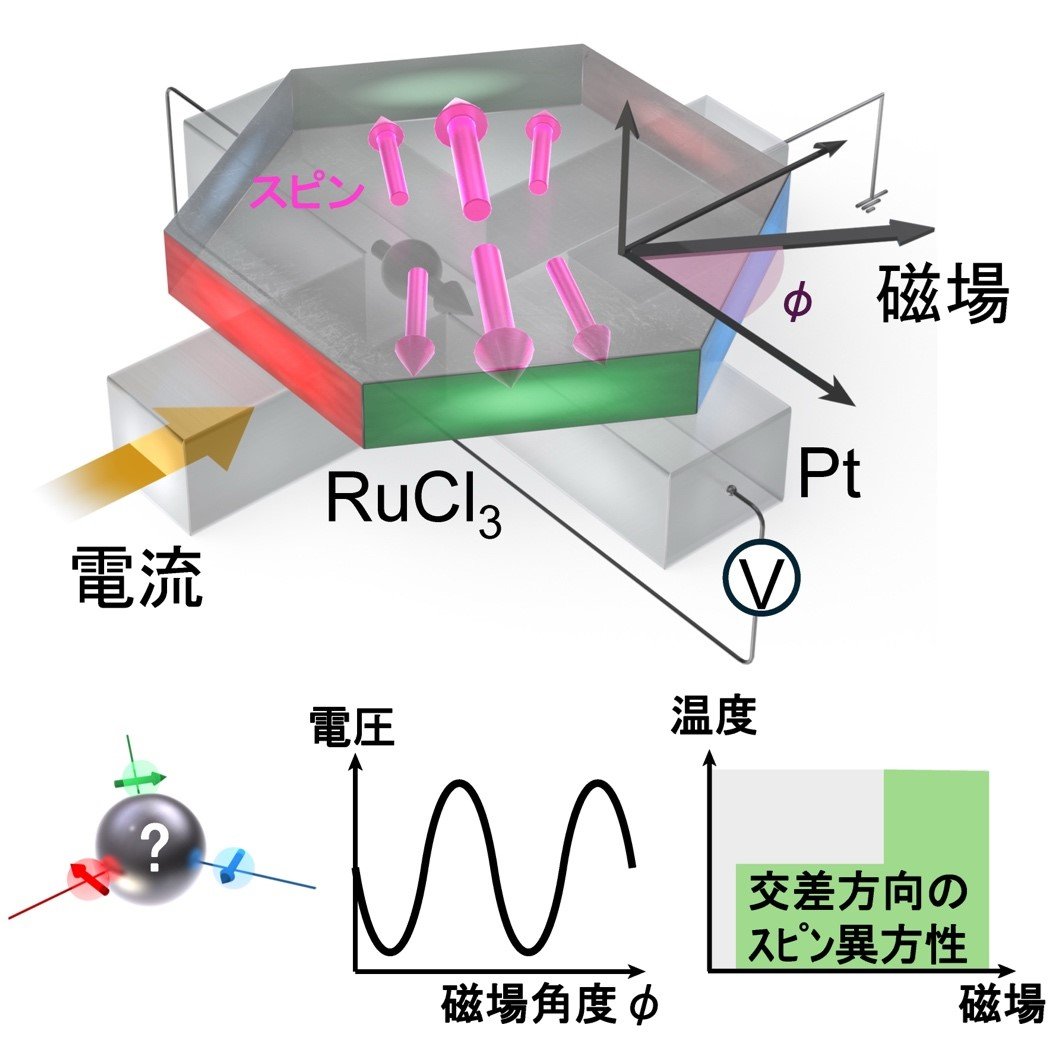
図1. スピン素子の模式図(上図)、格子上の異方的相互作用によるスピン液体(下段左図)、電気的な振動信号(下段中央図)、交差方向のスピン異方性が幅広く観測された(下段右図)。
<関連情報>
- https://www.tohoku.ac.jp/japanese/2026/04/press20260423-02-spin.html
- https://www.tohoku.ac.jp/japanese/newimg/pressimg/tohokuuniv-press20260423_02web_spin.pdf
- https://www.cell.com/newton/fulltext/S2950-6360(26)00107-6
スピンホール磁気抵抗によるスピン液体候補α- RuCl₃における磁場横方向スピン異方性の解明 Unveiling field-transverse spin anisotropy in the spin liquid candidate α-RuCl3 via spin Hall magnetoresistance
Hiroshi Idzuchi ∙ Motoi Kimata ∙ Satoshi Okamoto ∙ … ∙ David Mandrus ∙ Arnab Banerjee ∙ Yong P. Chen
Newton Published:April 22, 2026
DOI:https://doi.org/10.1016/j.newton.2026.100505
Accessible overview
Quantum spin liquids (QSLs) are an unusual class of magnetic materials in which electron spins remain disordered and entangled at very low temperatures. This results in exotic excitations with potential for robust quantum information technologies. Among these states, Kitaev QSLs arise from strongly anisotropic interactions on a honeycomb lattice and are promising candidates for fault-tolerant quantum computation. However, candidate QSL materials are typically Mott insulators, lacking mobile charge carriers, which makes probing and manipulating their magnetic states with conventional electronic techniques challenging. This hampers efforts to integrate QSLs into devices and spintronic applications. Here, we demonstrate that magnetic correlations in the Kitaev candidate α-RuCl3 can be electrically detected via a neighboring metal layer. Using platinum, a prototypical spin Hall metal, we perform spin-sensitive transport measurements, revealing a characteristic spin Hall magnetoresistance (SMR) signal resulting from interactions between spin-injecting currents in the metal and local magnetic moments in the insulator. The SMR manifests as angular resistance oscillations as the in-plane magnetic field is rotated relative to the current. These oscillations are observed across multiple magnetic regimes of α-RuCl3, including the zigzag antiferromagnetic state at low magnetic fields, the putative QSL phase at intermediate fields, and the partially field-polarized states at higher fields. The phase of the SMR oscillations suggests that the local moments, whether static or fluctuating, develop an in-plane anisotropy with a spin quantization axis largely aligned perpendicular to the magnetic field. Temperature-dependent measurements suggest that this spin anisotropy operates at an energy scale comparable to QSL signatures in α-RuCl3. Our results establish spin-sensitive electronic transport as an effective probe of magnetic correlations in insulating quantum materials, opening pathways for electrical access and manipulation of exotic magnetic states for future spintronic and quantum technologies.
Highlights
- Spin device to probe magnetic moments in spin liquid candidate insulator α-RuCl3
- Interplay between the spin Hall effect in Pt and local magnetic moments in α-RuCl3
- Resistance oscillations of Pt observed with various phases and states in α-RuCl3
- Phase diagram in α-RuCl3 is studied with observed B-transverse anisotropy
Summary
α-RuCl3 has emerged as a possible candidate for a quantum spin liquid (QSL) that promises exotic quasiparticles relevant for fault-tolerant quantum computation. Here, we report spin-sensitive transport measurements using a proximal spin Hall metal, platinum (Pt), to probe magnetic moments in the insulator α-RuCl3. We observe spin Hall magnetoresistance (SMR), where both the transverse and longitudinal resistivities exhibit angular oscillations between the in-plane magnetic field and the current, driven by the interplay between the spin Hall effect in Pt and local magnetic moments in α-RuCl3. These oscillations occur from 1.5 to 18 T, covering the zigzag antiferromagnetic, putative QSL, and supposedly partially field-polarized phases. The phase of the SMR oscillations suggests that the local moments, whether static or fluctuating, develop spin anisotropy with a quantization axis in-plane and largely transverse to the magnetic field across all fields from 1.5 to 18 T. Temperature dependence indicates that the spin anisotropy operates at an energy scale similar to that of the reported QSL signatures in α-RuCl3.