2026-04-15 アルゴンヌ国立研究所(ANL)
<関連情報>
- https://www.anl.gov/article/how-will-tropical-cyclones-impact-coastal-critical-infrastructure-including-nuclear-reactors-in-the
- https://www.nature.com/articles/s44304-026-00175-x
ベンガル湾における熱帯低気圧による高潮リスクの重要インフラへの影響予測 Projections of tropical cyclone-driven storm-tide risk to critical infrastructure in the Bay of Bengal
Coleman P. Blakely,William J. Pringle & V. R. Kotamarthi
njp Natural Hazards Published:27 February 2026
DOI:https://doi.org/10.1038/s44304-026-00175-x
Abstract
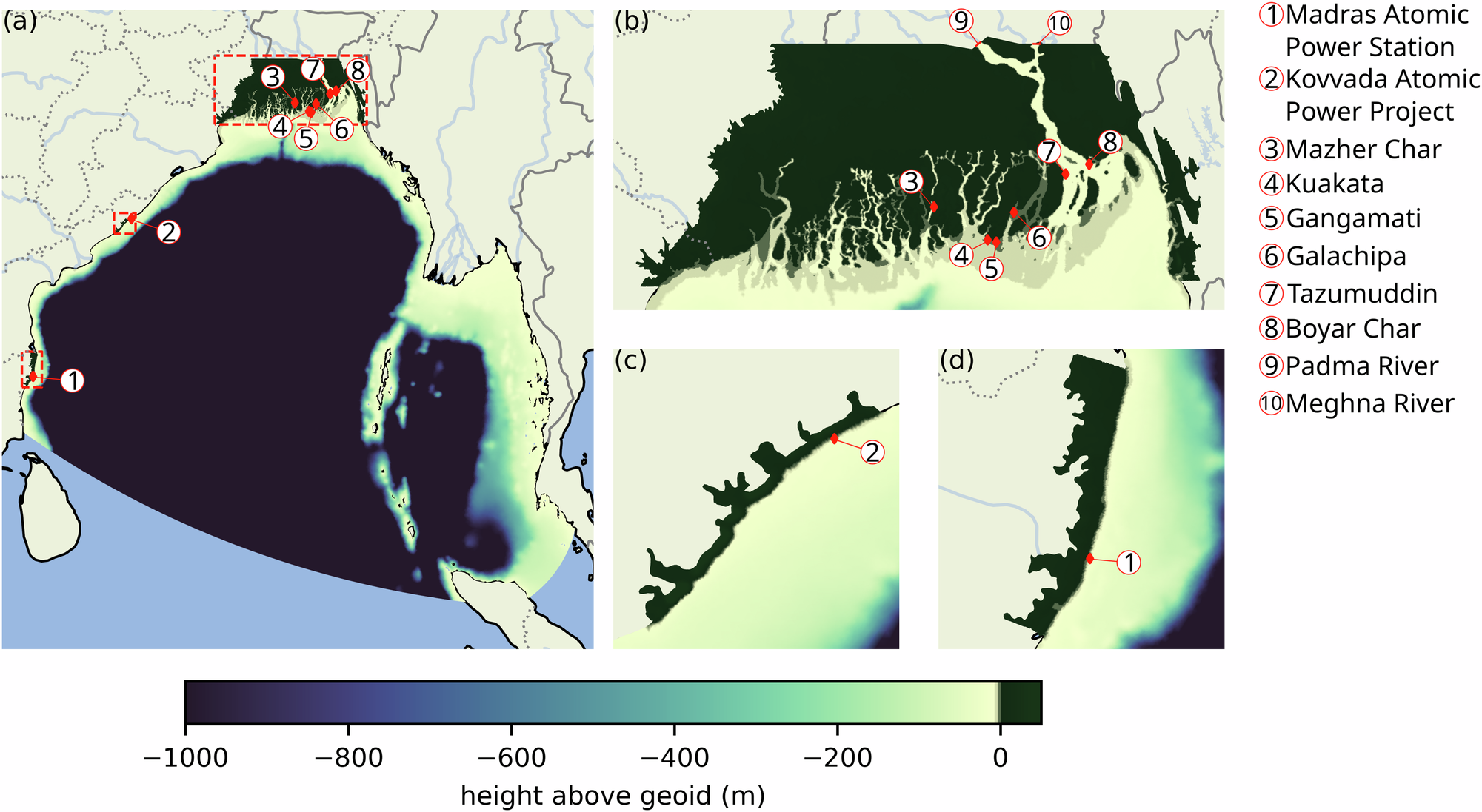
Due to its low elevation and densely populated coast, the Bay of Bengal (BoB) is uniquely vulnerable to tropical cyclone (TC)-driven storm-tides. This study uses a high-resolution, coupled hydrodynamic and wave model of the BoB to simulate several millennia of present and future climate synthetic tropical cyclones. We quantify nonlinear interactions among storm surge, tides, river discharge, and sea-level rise. While results reveal strong spatial variability, wave runup, tide-surge, and the interaction of mean sea levels and surge are the strongest of these processes. Using combinations of forcing states, we generate a dataset of storm-tide levels at sites of critical infrastructure and estimate long-term (>100-year) storm-tide return levels for present-day and mid-century conditions. Future scenarios project decreased flood risk across the eastern Ganges-Brahmaputra-Meghna delta but heightened risk along India’s eastern coast, where the Kovvada Atomic Power Project may see up to a 78% increase in 5000-year storm-tide levels.