2026-04-16 スイス連邦工科大学ローザンヌ校(EPFL)
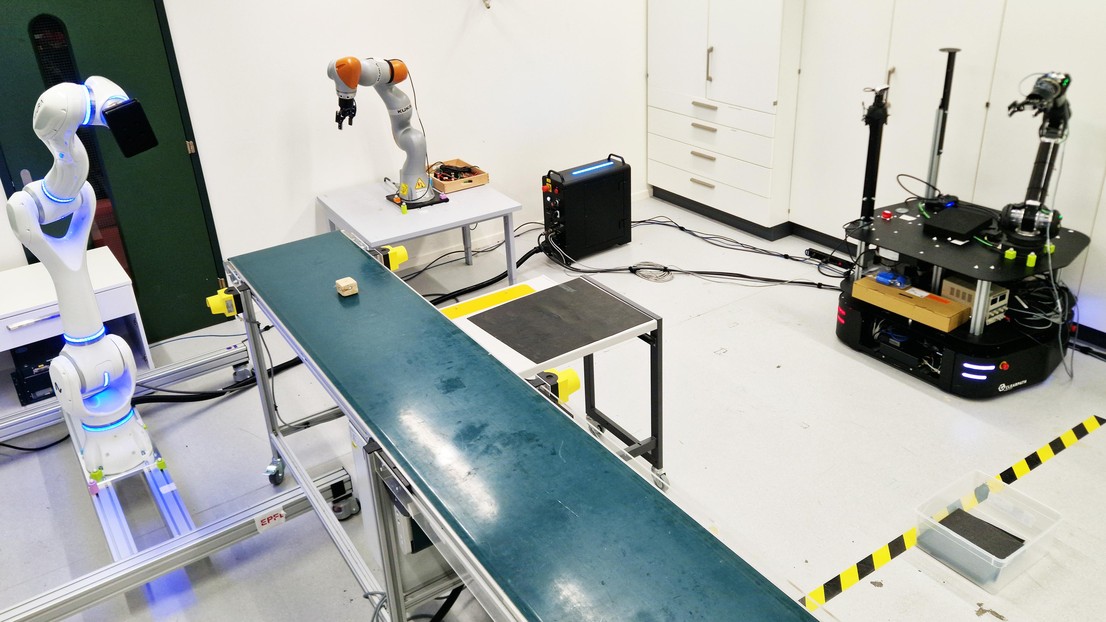
The assembly line task setup. 2026 LASA EPFL CC BY SA
<関連情報>
- https://actu.epfl.ch/news/how-to-teach-the-same-skill-to-different-robots-2/
- https://www.science.org/doi/10.1126/scirobotics.aea1995
一度実証すれば、複数台で実行可能:ロボット間スキル転移のための運動学的知能 Demonstrate once, execute on many: Kinematic intelligence for cross-robot skill transfer
Sthithpragya Gupta, Durgesh Haribhau Salunkhe, and Aude Billard
Science Robotics Published:15 Apr 2026
DOI:https://doi.org/10.1126/scirobotics.aea1995
Abstract
Teaching robots new skills should be as natural as showing rather than programming. Learning from demonstration (LfD) moves toward this goal by allowing users to guide a robot or sketch a desired motion, enabling learning without writing a line of code. However, most LfD methods remain tied to the robot they were trained on. Changes in morphology, different link lengths, joint orientations, or limits often break the learned behavior, making retraining unavoidable. Here, we introduce a framework that endows robots with kinematic intelligence: an internal understanding of their own joint limits, singularities, and connectivity. Instead of correcting for these constraints after learning, we embedded them directly into the control policy from the outset. The approach takes one or multiple demonstrations, extracts a globally stable dynamical system, and produces behaviors that remain valid across robots with different kinematic structures. Our method is grounded in a comprehensive analytical classification of noncuspidal three-revolute (3R) robots, which form the building blocks of many commercial robots. This classification enables a joint space policy that preserves user intent and adapts to robot-specific constraints. We validated the framework on diverse simulated and real robots, both redundant and nonredundant, with varied link geometries and joint configurations. The demonstrated skill executes safely and consistently across robots without retuning, thereby achieving cross-robot skill transfer.