2026-03-03 ハーバード大学
<関連情報>
- https://seas.harvard.edu/news/snakes-plane
- https://royalsocietypublishing.org/rsif/article/23/235/20250314/480507/Postural-control-in-an-upright-snake
- https://journals.biologists.com/jeb/article/220/19/3545/18804/Three-dimensional-trajectories-affect-the-epaxial
直立したヘビの姿勢制御 Postural control in an upright snake
Ludwig A. Hoffmann;Petur Bryde;Ian C. Davenport;S. Ganga Prasath;Bruce C. Jayne;L. Mahadeva
Journal of the Royal Society Interface Published:25 Feb 2026
DOI:https://doi.org/10.1098/rsif.2025.0314
Abstract
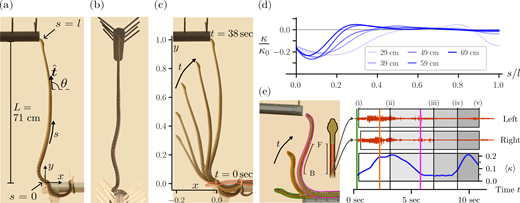
Posture and its control are fundamental aspects of animal behaviour that capture the complex interplay between sensorimotor activity that is driven by muscular forces, and environmental feedback that is mediated by proprioception and active control. An extreme example of this is seen in brown tree snakes and juvenile pythons: they can stand almost upright, with 70% of their body length in the air. We quantify experimental observations of this behaviour and present a minimal theoretical framework for postural stability by modelling the snake as an active elastic filament whose shape is controlled by muscular forces. We explore two approaches to characterize the musculature needed to achieve a specific posture: proprioceptive feedback (whereby the snake senses and reacts to its own shape) and a control-theoretic optimization approach (whereby the snake minimizes the expended energy to stand up). Then we also analyse the dynamic stability of the snake in its upright pose. Our results lead to a three-dimensional postural stability diagram in terms of muscle actuation and strength, and gravity, consistent with experimental observations. In addition to general predictions about posture control in animals, our study suggests design principles for robotic mimics.
3次元軌道は、隙間を渡る樹上性ヘビの体軸上筋活動に影響を与える Three-dimensional trajectories affect the epaxial muscle activity of arboreal snakes crossing gaps
Ryan M. Jorgensen,Bruce C. Jayne
Journal of Experimental Biology Published:01 October 2017
DOI:https://doi.org/10.1242/jeb.164640
ABSTRACT
The need for long-axis support is widespread among non-aquatic vertebrates and may be particularly acute for arboreal snakes when many vertebrae span sizable gaps between branches with diverse orientations. Hence, we used brown tree snakes (Boiga irregularis) bridging gaps to test how three-dimensional trajectories affected muscle activity and whether these motor patterns differed from those for the locomotion of terrestrial snakes and movements of other vertebrates. We used five trajectories: pitch angles of 90, 0 and −90 deg (downward) when yaw=0 deg, and 90 deg yaw angles to the left and right when pitch=0 deg. We recorded movement and electromyograms from the three largest epaxial muscles, which from dorsal to ventral are the semispinalis-spinalis (SSP), longissimus dorsi (LD) and iliocostalis (IL). Overall, the SSP had extensive bilateral activity, which resembled the motor pattern during the dorsiflexion of sidewinding snakes. Unlike any previously described terrestrial snake locomotion, bilateral activity of the LD and IL was also common during gap bridging. The largest amounts of muscle activity usually occurred for horizontal gaps, and muscle activity decreased markedly as soon as the snake’s head touched the far edge of the gap. Snakes had the least amount of muscle activity for pitch=−90 deg. While turning sideways, muscles on the convex side had less activity when turning compared with the concave side. Hence, the orientation relative to gravity profoundly affected muscle activity during gap bridging, and these complex three-dimensional movements involved several previously undescribed variants of axial motor pattern.