2026-04-16 物質・材料研究機構
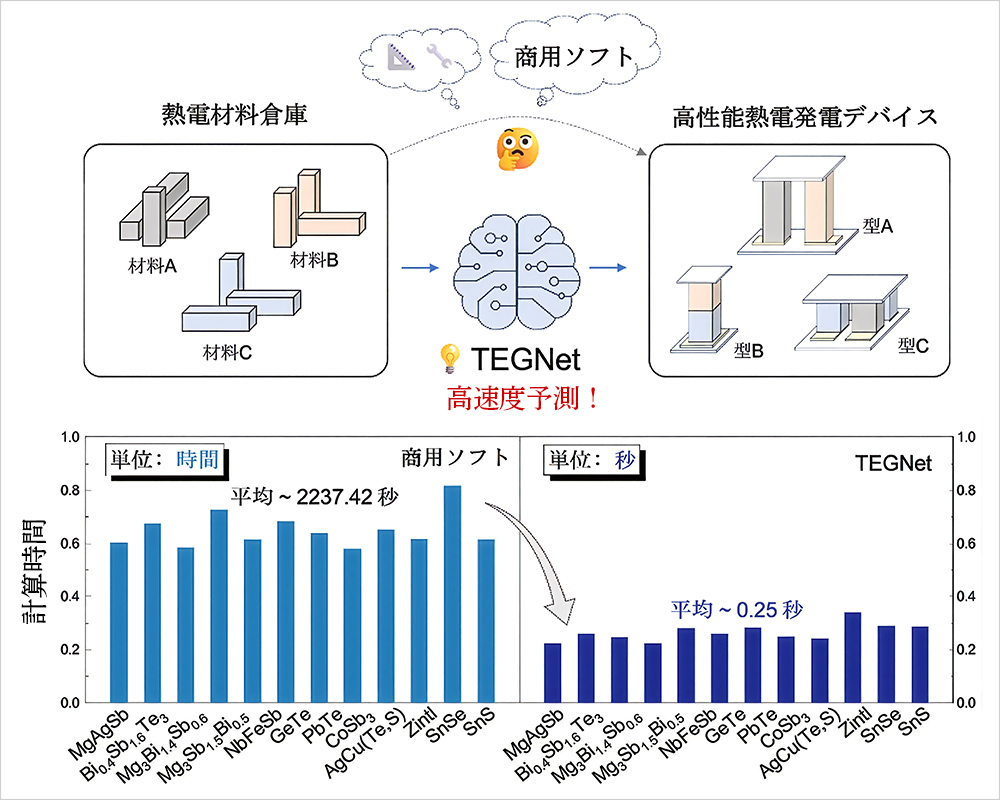
図: AIモデル「TEGNet」による熱電デバイス性能予測の大幅高速化 (計算時間を従来比約1万分の1に短縮)
<関連情報>
- https://www.nims.go.jp/press/2026/04/202604160.html
- https://www.nims.go.jp/press/2026/04/p4q589000000ct2a-att/202604160.pdf
- https://www.nature.com/articles/s41586-026-10223-1
構成可能なニューラルエミュレータが熱電発電機の設計を加速する Composable neural emulators accelerate thermoelectric generator design
Airan Li,Xinzhi Wu,Longquan Wang,Gang Wu,Jiankang Li,Zhao Hu,Xinyuan Wang & Takao Mori
Nature Published:15 April 2026
DOI:https://doi.org/10.1038/s41586-026-10223-1
Abstract
Designing high-performance thermoelectric (TE) devices is challenging because it requires not only advanced materials but also optimal configurations, which are critical for maximizing device performance but remain time-consuming and resource-intensive to identify1,2,3,4,5. Here we develop TEGNet, a neural network emulator that predicts TE generator performance with greater than 99% accuracy while using only 0.01% of the computational time required by commercial finite-element solvers. TEGNet exhibits strong architectural generality across various material systems and allows flexible combinations of material-specific emulators, unlocking rapid and accurate exploration of diverse device architectures. Using TEGNet, we experimentally optimize MgAgSb/Bi0.4Sb1.6Te3 segmented and Mg3Bi1.4Sb0.6–MgAgSb n–p paired TE generators, achieving conversion efficiencies of 9.3% and 8.7%, respectively, ranking competitively high among those previously reported6,7,8,9,10. This work demonstrates the power of artificial intelligence (AI) in TE generator design, inspiring further research on AI for thermoelectrics.