2026-04-14 東北大学
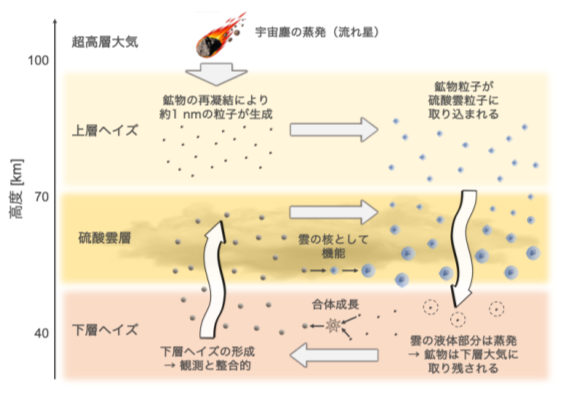
図1. 本研究が明らかにした下層ヘイズの形成メカニズム。 上空から降り注いだ宇宙塵が硫酸の雲に取り込まれ、雲底で硫酸が蒸発した後に大気に取り残され合体成長し、下層ヘイズが作られる。
<関連情報>
- https://www.tohoku.ac.jp/japanese/2026/04/press20260414-03-Venus.html
- https://www.tohoku.ac.jp/japanese/newimg/pressimg/tohokuuniv-press20260414_03web_Venus.pdf
- https://www.nature.com/articles/s41550-026-02843-4
金星の下層部の霞の宇宙起源 A cosmic origin of Venus’ lower haze
Hiroki Karyu,Takeshi Kuroda,Anni Määttänen,Arnaud Mahieux,Sébastien Viscardy,Naoki Terada,Séverine Robert,Ann Carine Vandaele & Michel Crucifix
Nature Astronomy Published:13 April 2026
DOI:https://doi.org/10.1038/s41550-026-02843-4
Abstract
Entry probes have revealed a layer containing involatile submicrometre particles—the lower haze—between Venus’ surface and the main cloud deck. However, its origin is still unclear, and atmospheric models have mostly treated it as a lower boundary condition, despite the known role of its particles as condensation nuclei when they are transported to the main cloud deck. Here we incorporate a self-consistent particle formation framework into a Venus cloud microphysics model and show that the continuous influx of cosmic dust is sufficient to sustain this lower haze layer with the particle size distribution observed by the entry probes. These haze particles of cosmic origin act as efficient condensation nuclei, promoting cloud formation in the main cloud deck even far from their initial source. Furthermore, these particles are enriched in metallic species, specifically magnesium and iron; the latter represents a plausible source for the planet’s long-unidentified ultraviolet absorber. Collectively, our findings establish cosmic dust as an essential component of Venus’ climate. These insights are also crucial for understanding the climates of planets with thick atmospheres, such as gas giants and exoplanets, where accumulating cosmic dust can similarly affect the cloud structure and composition.