2026-04-13 カリフォルニア大学リバーサイド校(UCR)
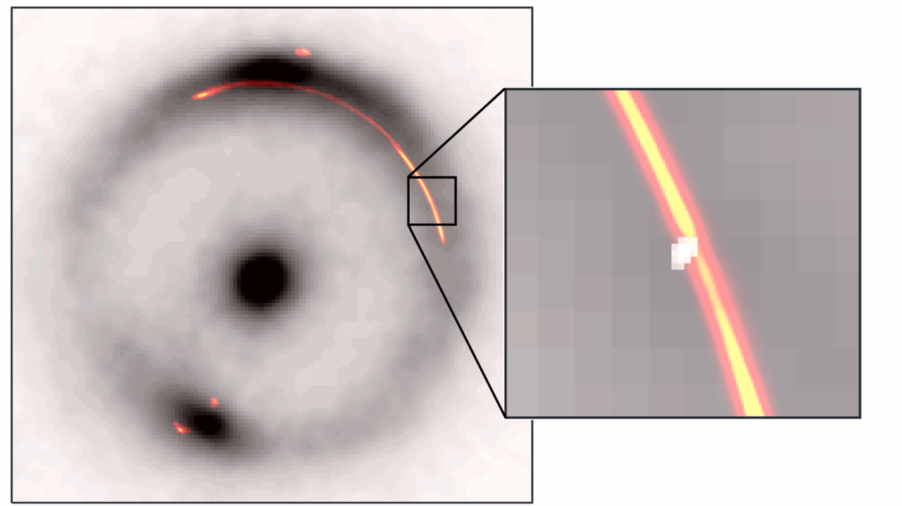
The gravitational lens system JVAS B1938+666. The black ring and central dot show an infrared image of a distant galaxy distorted by gravitational lensing. The orange emission shows radio waves from the same system. The inset highlights a small “pinch” in the image caused by an additional dense object — about a million times the mass of the Sun — shown as a white blob. Credit: Devon Powell, Max Planck Institute for Astrophysics, based on data from Keck/EVN/GBT/VLBA.
<関連情報>
- https://news.ucr.edu/articles/2026/04/13/self-interacting-dark-matter-may-solve-three-cosmic-puzzles
- https://journals.aps.org/prl/abstract/10.1103/txxx-97ln
中心核崩壊型SIDMハローは、レンズ状構造、ストリーム状構造、および衛星状構造における高密度擾乱天体の共通起源である Core-Collapsed SIDM Halos as the Common Origin of Dense Perturbers in Lenses, Streams, and Satellites
Hai-Bo Yu
Physical Review Letters Published: 9 April, 2026
DOI: https://doi.org/10.1103/txxx-97ln
Abstract
We show that core-collapsed self-interacting dark matter halos of mass ∼106M⊙, originally simulated to explain the dense perturber of the GD-1 stellar stream, also reproduce the structural properties inferred for the dense perturber detected in the strong lensing system JVAS B1938+666 from radio observations. Furthermore, these halos are sufficiently compact and dense to gravitationally capture field stars in satellite galaxies of the Milky Way, providing a natural explanation for the origin of Fornax 6, a stellar cluster in the Fornax dwarf spheroidal galaxy. Our results demonstrate that observations of halos with similar masses but residing in different cosmic environments offer a powerful and complementary probe of self-interacting dark matter.