2026-04-13 早稲田大学
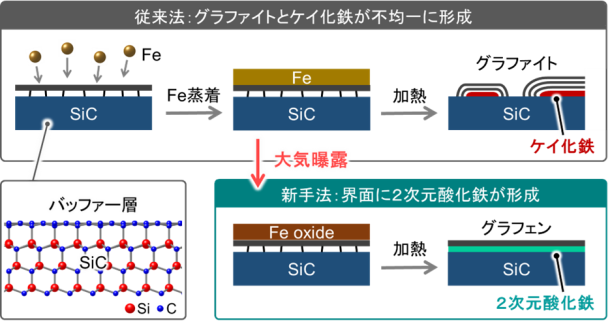
図1 インターカレーションによる2次元酸化鉄の作製方法
<関連情報>
- https://www.waseda.jp/inst/research/news/83993
- https://onlinelibrary.wiley.com/doi/10.1002/smtd.202501889
グラフェン/SiC(0001)界面における2次元酸化鉄 2D Iron Oxide at the Graphene/SiC(0001) Interface
Ryotaro Sakakibara, Tomo-o Terasawa, Taizo Kawauchi, Katsuyuki Fukutani, Takahiro Ito, Wataru Norimatsu
Small Methods Published: 14 March 2026
DOI:https://doi.org/10.1002/smtd.202501889
ABSTRACT
Fabrication of two-dimensional (2D) transition-metal oxides has gained considerable attention due to their unique crystal structures and physical properties distinct from their bulk counterparts. Intercalation of foreign elements into the graphene/SiC(0001) interface is a possible approach for achieving this, as it enables the confinement and arrangement of atoms within the 2D interface. However, while various 2D metals and their compounds have been synthesized at the graphene/SiC interface, the fabrication of 2D transition-metal compounds remains challenging. This difficulty arises from the high reactivity of transition metals such as Fe, Co, and Ni, which readily form carbides and silicides with the host material. In this work, the fabrication of a 2D iron oxide at the graphene/SiC interface is demonstrated through the simultaneous intercalation of Fe and O. Direct observation using atomic-resolution electron microscopy revealed that the crystalline 2D iron oxide is encapsulated by graphene and forms a sharp interface with the SiC substrate. Structural analysis and Mössbauer spectroscopy suggest that the 2D iron oxide exhibits a wüstite-like structure. These findings provide another strategy for synthesizing 2D transition-metal oxides, opening new avenues for the advancement of 2D magnetic materials.