2026-03-26 東京科学大学
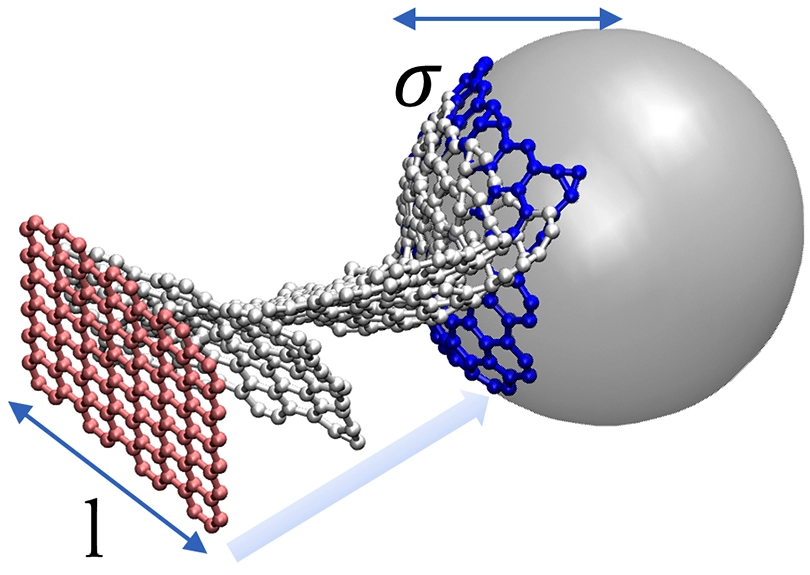
図1. グラフェンフレークと仮想球面との相互作用のシミュレーション。
ピンク色は初期位置のグラフェンフレーク、灰色の球体は仮想球面、白色と青色はそれぞれ中間状態と最終状態を示し、球面との相互作用によってグラフェンが湾曲する過程を表している。
<関連情報>
- https://www.isct.ac.jp/ja/news/94mzpkhbbia0#top
- https://link.springer.com/article/10.1007/s43939-025-00496-0
単層グラフェン薄片の平面から凸面への変形 Single layer graphene flake transformation from flat to convex
Phuc Vu Le,Phi Minh Nguyen,Hoa Van Nguyen,Vi Toan Lam,Hanh Thi-Thu Tran & Duy Phuoc Tran
Discover Materials Published:26 December 2025
DOI:https://doi.org/10.1007/s43939-025-00496-0
Abstract
The morphology of carbon-based materials primarily depends on the concentration of n-membered rings. A key question that remains unanswered is whether flat carbon flakes, like graphene, can directly transform into convex or spherical shapes, and how stable these convex structures are. Here, we reported our in-silico experiments to make the flat graphene flakes (perfect 6-membered rings) into the convex shapes by using reactive molecular dynamics simulations and density functional theory calculations by employing the inert pseudo-spheres with graphene flakes. The graphene flakes can fold at the middle or at the edge side of the sheet making the unique one-side-opened or two-side-opened structures. The convex graphene with higher radius of curvature tends to have more defects at the grain boundary, while the lower of that tends to form the (inversed) Stone-Wales defects to facilitate the fullerene conformation. We found that the convex graphene was mostly stable at the radius from 1.0 nm to 5.0 nm. The obtained graphene conformations exhibit the bonding properties of graphene in curvature radius above 1 nm are unchanged. The tensions of the structures are mainly distributed at the edges and tend to point outward. The electronic distributions of graphene sheets are inhomogeneous and vary significantly via the morphology of the sheets.