2026-04-15 中国科学院(CAS)
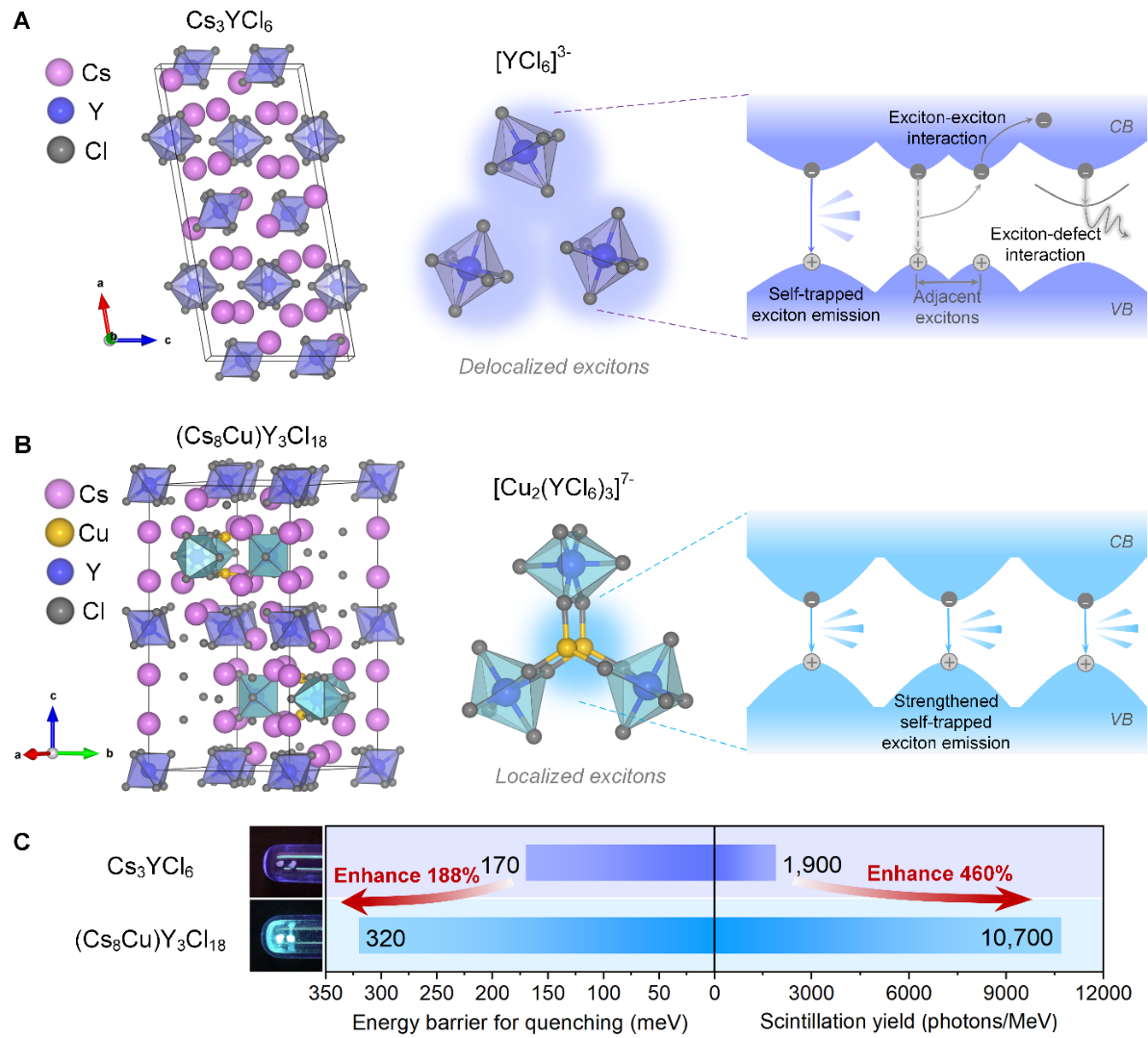
Strong Confined Exciton Luminescence in Low-Dimensional Metal Halides Achieved Through Structural Modulation (Image by SICCAS)
<関連情報>
- https://english.cas.cn/newsroom/research-news/202605/t20260509_1158652.shtml
- https://spj.science.org/doi/10.34133/research.1230
励起子閉じ込め操作によるゼロ次元ハロゲン化物における巨大なシンチレーション収量向上 Giant Scintillation Yield Enhancement in Zero-Dimensional Halides by Exciton Confinement Manipulation
Yujie Wang, Xuemin Wen, Hongliang Shi, Eva Mihóková, […] , and Yuntao Wu
Research Published:14 Apr 2026
DOI:https://doi.org/10.34133/research.1230
Abstract
Low-dimensional halides (LDHs) with self-trapped exciton (STE) emission are promising materials for scintillation applications. Nonetheless, for almost all LDHs, the measured scintillation yield is still far below theoretical value due to severe exciton–exciton/exciton–defect interaction under ionizing radiation, despite high photoluminescence quantum yield (PLQY). Here, we reported a substantial enhancement of scintillation yield in zero-dimensional (0D) Cs3YCl6 by structural modulation. By copper(I) alloying in Cs3YCl6, the delocalized excitons in [YCl6]3− octahedra convert to strongly localized excitons within [Cu2(YCl6)3]7− clusters in (Cs8Cu)Y3Cl18, as confirmed by first-principles calculations. Temperature-dependent photoluminescence spectroscopy and kinetic results reveal a higher energy barrier for STE quenching in (Cs8Cu)Y3Cl18 than in Cs3YCl6. Benefiting from the enhanced exciton confinement effect, (Cs8Cu)Y3Cl18 exhibits a 460% enhancement in the STE-related scintillation yield. This work opens up a new strategy to enhance scintillation yield in LDHs under ionizing radiation excitation.