2026-03-17 東京科学大学
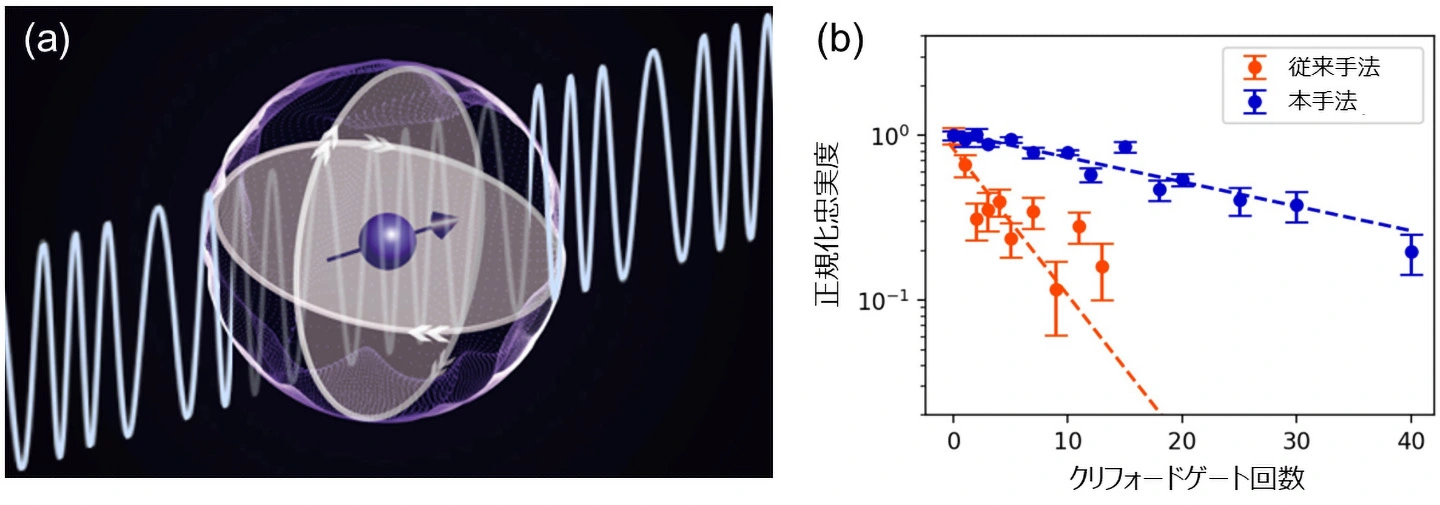
図1. (a)マイクロ波位相変調を用いた本方式により、量子ビットの状態が安定している様子。(b)ランダマイズド・ベンチマーキングによって評価した単一量子ビット操作の忠実度測定結果。従来手法ではクリフォードゲート数の増加に伴い忠実度が減衰するのに対し、本手法では減衰が抑制されている。この測定結果から単一量子ビットゲート忠実度として99.1%を得た。
<関連情報>
位相変調を用いた天然Si-MOS量子ドットにおける堅牢なスピン量子ビット制御 Robust spin-qubit control in a natural Si-MOS quantum dot using phase modulation
Takuma Kuno,Takeru Utsugi,Andrew J. Ramsay,Normann Mertig,Noriyuki Lee,Itaru Yanagi,Toshiyuki Mine,Nobuhiro Kusuno,Raisei Mizokuchi,Takashi Nakajima,Shinichi Saito,Digh Hisamoto,Ryuta Tsuchiya,Jun Yoneda,Tetsuo Kodera & Hiroyuki Mizuno
npj Quantum Information Published:21 January 2026
DOI:https://doi.org/10.1038/s41534-026-01185-3
Abstract
Silicon quantum dots are one of the most promising candidates for practical quantum computers because of their scalability and compatibility with the well-established complementary metal-oxide-semiconductor technology. However, the coherence time is limited in industry-standard natural silicon because of the 29Si isotopes, which have non-zero nuclear spin. Here, we protect an isotopically natural silicon metal-oxide-semiconductor (Si-MOS) quantum dot spin qubit from environmental noise via electron spin resonance with a phase-modulated microwave (MW) drive. This concatenated continuous drive (CCD) method extends the decay time of Rabi oscillations from 1.2 μs to over 200 μs. Furthermore, we define a protected qubit basis and propose robust gate operations. We find the coherence time measured by Ramsey sequence is improved from 143 ns to 40.7 μs compared to that of the bare spin qubit. The single qubit gate fidelity measured with randomized benchmarking is improved from 95% to 99%, underscoring the effectiveness of the CCD method. The method shows promise for improving control fidelity of noisy qubits, overcoming the qubit variability for global control, and maintaining qubit coherence while idling.