2026-05-15 合肥物質科学研究院(HFIPS)
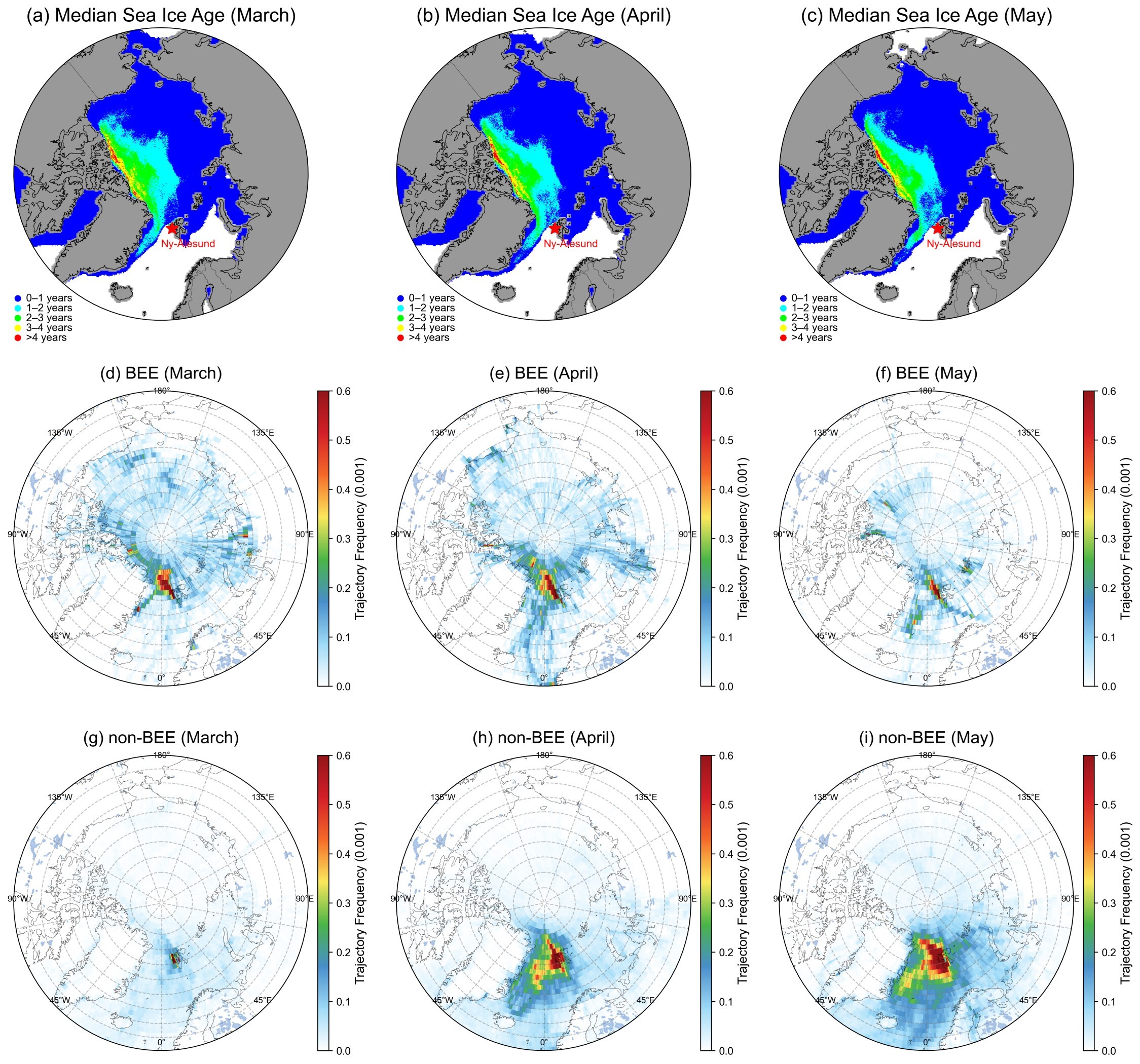
Monthly median sea ice age (a–c) and the frequency of air masses along the 5 d backward trajectories when the air masses are below 500 m during BEEs (d–f) and non-BEEs (g–i) in Ny-Ålesund for March, April, and May during 2017–2023. (Image by LI Qidi)
<関連情報>
- https://english.hf.cas.cn/nr/bth/202605/t20260515_1159451.html
- https://acp.copernicus.org/articles/26/6165/2026/
ニーオーレスンにおける対流圏臭素一酸化物:発生源分析と大気化学への影響 Tropospheric bromine monoxide in Ny-Ålesund: source analysis and impacts on atmospheric chemistry
Qidi Li, Yuhan Luo, Xin Yang, Bianca Zilker, Andreas Richter, Ke Dou, Haijin Zhou, Kai Zhan, Fuqi Si, and Wenqing Liu
Atmospheric Chemistry and Physics Published:08 May 2026
DOI:https://doi.org/10.5194/acp-26-6165-2026
Abstract
Arctic tropospheric bromine monoxide (BrO) plays a critical role in atmospheric chemistry, particularly during springtime ozone depletion events. While sources such as sea ice, open ocean, aerosols, and snowpack have been proposed, their relative contributions remain uncertain. In this study, we addressed this uncertainty using long-term Multi-Axis Differential Optical Absorption Spectroscopy observations of BrO and aerosol profiles in Ny-Ålesund, Svalbard (78.92° N, 11.93° E), collected from March–May 2017–2023. BrO enhancements are positively correlated with aerosol extinction, indicating a close association with airborne particles, as supported by a Chemistry Transport Model (p-TOMCAT) simulations showing that heterogeneous recycling on aerosols is essential for sustaining elevated BrO levels. Five-day backward trajectories (0–3 km) showed significant BrO correlation with sea-ice contact time, particularly over multi-year ice (MYI) regions, which contributes comparably to first-year ice (FYI) regions in the total blowing-snow-sourced bromine flux, highlighting the comparable importance of snow over MYI and FYI regions in driving bromine explosion events. In addition, strong winds cause enhanced reactive bromine release from the sea ice. BrO and aerosol variability show a seasonal shift, with sea ice dominating in early spring and open ocean influence increasing toward late spring. BrO correlated negatively with surface ozone and mercury, indicating that enhanced bromine drives both ozone and mercury depletion. In particular, observed BrO correlated positively with modelled blowing-snow-sourced sea salt aerosol and the corresponding bromine emission fluxes from blowing snow. Snowpack-sourced bromine fluxes also correlated with BrO, although disentangling release processes remains challenging.