2026-03-05 日本原子力研究開発機構
<関連情報>
- https://www.jaea.go.jp/02/press2025/p26030501/
- https://www.sciencedirect.com/science/article/abs/pii/S1385894725132725
同位体交換平衡シフトによるPEM水電気分解における重水素濃縮効率の向上 Enhancement of deuterium enrichment efficiency in PEM water electrolysis via isotope exchange equilibrium shift
Masahiro Yano, Shinji Kubo, Satoshi Yasuda
Chemical Engineering Journal Available online: 2 January 2026
DOI:https://doi.org/10.1016/j.cej.2025.172423
Highlights
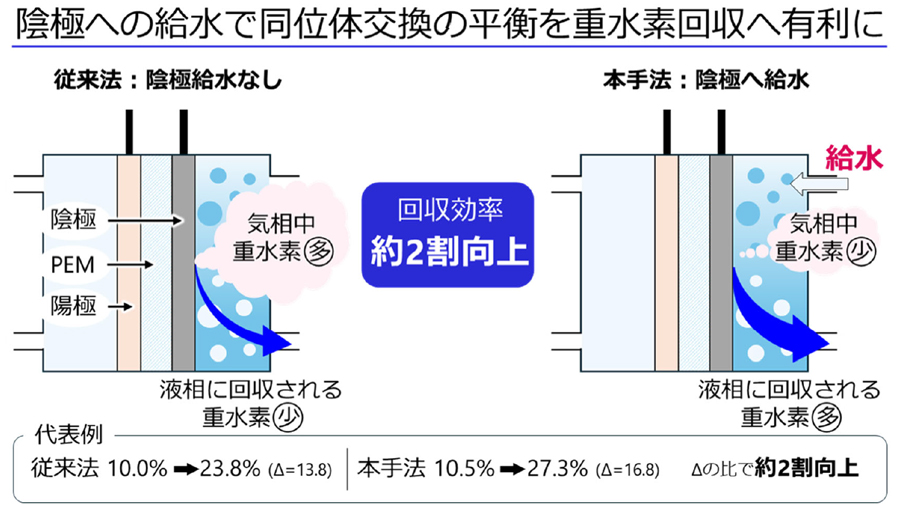
- A new isotope separation method for PEM-WE by controlling cathode-side deuterium concentration.
- Cathode water addition controls D concentration, boosting LPCE shift, separation factor, and enrichment efficiency.
- Demonstrated 10–20% higher D enrichment over conventional methods across a wide range of initial D concentrations.
- Theoretical simulations based on chemical equilibrium support experimental results and proposed mechanisms.
Abstract
This study presents an in-situ, liquid phase catalytic exchange (LPCE)-based process-intensification approach for hydrogen-isotope separation in proton-exchange membrane water electrolysis (PEM-WE). Supplying water directly to the cathode enables deliberate tuning of the local isotopic composition at the catalyst surface, which in turn enhances both the separation factor and the deuterium enrichment efficiency. A chemical-equilibrium model reproduces these trends by attributing the gain to a thermodynamic shift of the LPCE toward the liquid phase at the cathode. The effectiveness of the method was validated across a wide range of initial deuterium concentrations in the anode feedwater and under high current densities, indicating its versatility. This approach offers a promising and practical strategy for efficient hydrogen isotope separation using PEM-WE.