2026-10-27 中国科学院(CAS)
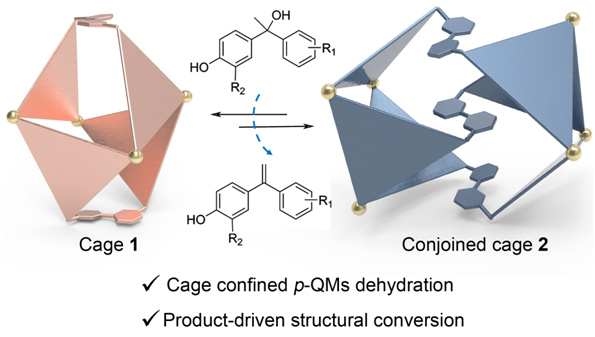
An adaptive Pd4L2 cage catalyzes the dehydration of p-QM precursors and undergoes product-triggered transformation into a Pd6L3 conjoined cage. (Image by Prof. SUN’s group)
<関連情報>
- https://english.cas.cn/newsroom/research-news/202610/t20261027_1212586.shtml
- https://onlinelibrary.wiley.com/doi/10.1002/anie.8746400
p-キノンメチド前駆体の触媒的脱水反応を介した、Pd4L2からPd6L3結合ケージへの生成物誘発適応進化 Product-Triggered Adaptive Evolution From a Pd4L2 to a Pd6L3 Conjoined Cage via Catalytic Dehydration of p‑Quinone Methide Precursors
Chen-Chen Li, Ke-Han Tang, Pei-Ming Cheng, Shao-Jun Hu, Li-Peng Zhou, Li-Xuan Cai, Qing-Fu Sun
Angewandte Chemie International Edition Published: 24 September 2026
DOI:https://doi.org/10.1002/anie.8746400
Abstract
Supramolecular chemistry aims to emulate the dynamic structural adaptations and induced-fit conformational changes of enzymes that are fundamental to their biological function. In this work, we synthesized an adaptive Pd4L2 coordination cage using the newly developed pyridinium-based ligand L with cis-capped Pd (II) salt. Upon guest encapsulation, conformational adjustment provides direct structural evidence for the adaptive nature of cage 1 by X-ray crystallographic study. Within the hydrophobic pocket of the capsule, 4-(1-hydroxy-1-phenylethyl) phenol (S1), a known para-quinone methide (p-QM) precursor, undergoes spontaneous dehydration to the alkene product P1 in water. Kinetic studies and control experiments reveal that the cage 1 plays a vital role in significantly accelerating the dehydration process, affording the alkene product with markedly enhanced efficiency compared to the background reaction. Then generated alkene products act as a chemical stimulus driving the transformation of Pd4L2 to a Pd6L3 conjoined cage through an induced-fit mechanism, as unambiguously confirmed by SCXRD. This work offers fresh insights into enzyme-like adaptive behavior and unveils responsive supramolecular catalysis.