2026-10-26 中国科学院(CAS)
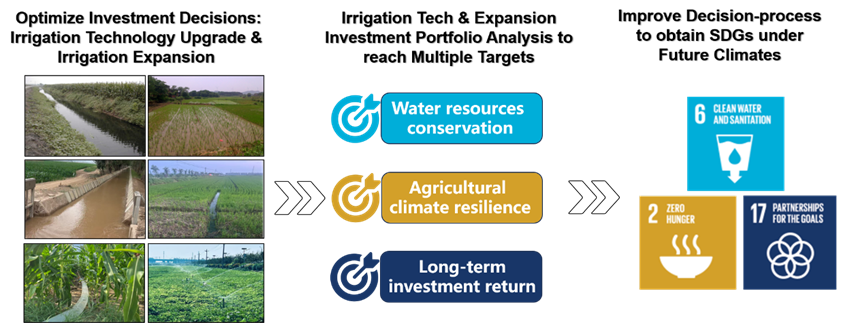
This conceptual graphical abstract illustrates that optimizing both irrigation technology upgrades and expansion is crucial to achieving multiple targets: water conservation, agricultural climate resilience, and long-term investment return. This study conducts an investment portfolio analysis to accelerate the government’s progress toward SDGs within irrigation infrastructure and high-standard farmland construction plans. (Image by ZHANG Tianyi and WANG Jinxia)
<関連情報>
- https://english.cas.cn/newsroom/research-news/202610/t20261026_1209413.shtml
- https://www.nature.com/articles/s43016-026-01455-5
灌漑技術の向上と的を絞った拡大を組み合わせることで、中国における節水型で気候変動に強い穀物生産が可能になる Coupling irrigation technology upgrades with targeted expansion enables water-efficient and climate-resilient cereal production in China
Tianyi Zhang, Jinxia Wang, Huang Chen, Yuting Liu, Wei Chao, Feng Zhou, Shaozhong Kang, Zhenong Jin, Weston Anderson & Robert O. Mendelsohn
Nature Food Published:23 October 2026
DOI:https://doi.org/10.1038/s43016-026-01455-5
Abstract
Irrigation expansion and water-saving technologies are essential for future water and food security, yet approaches that jointly improve resource conservation, yield stability and investment efficiency remain elusive. Here we integrate 42,190 county-level agricultural records, a nationally representative farmer survey comprising 3,576 observations and 2,230 controlled field experiments on maize, wheat and rice. We show that China’s shift towards more efficient irrigation reduced water use by 6.6–13.4% since 2010, but the continuation of historical trends is insufficient to meet national targets or protect yields under future climate change. We identify an optimized investment pathway that combines upgrades in existing irrigated areas with targeted expansion. This crop- and region-specific approach could raise yields by 0.1–10.9% while reducing water use by at least 25.5%, with rice offering the greatest savings potential. This framework provides actionable guidance for strategic irrigation investment in China to support sustainable agricultural intensification.