2026-10-19 中国科学院(CAS)
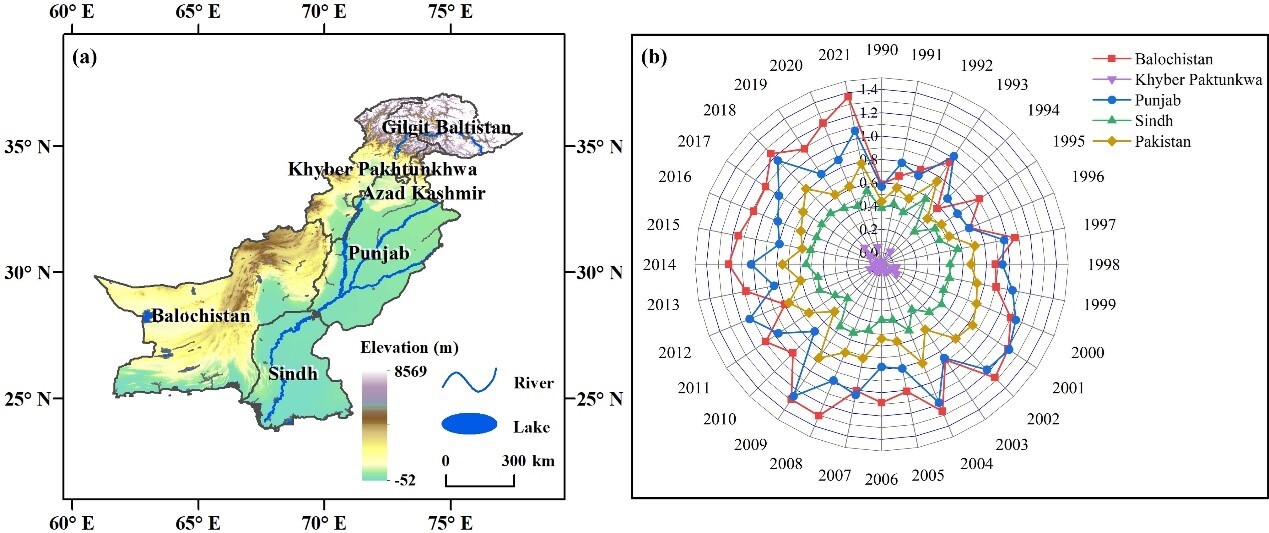
Changes in annual agricultural WSI in Pakistan and its provinces (1990–2021). (Image by SHEN Yanjun’s research group)
<関連情報>
- https://english.cas.cn/newsroom/research-news/202610/t20261026_1209361.shtml
- https://www.geogsci.com/EN/10.1007/s11442-026-2539-0
パキスタンにおける農業用水不足の変化とその要因 Changes in agriculture water scarcity and their driving factors in Pakistan
GUO Ying, WU Zongyang, ZHAO Chao, ZHANG Xiaolong, MUHAMMAD Zaman, SHEN Yan-jun, WANG Yanfang, SHEN Yanjun Journal of Geographical Sciences
DOI:https://doi.org/10.1007/s11442-026-2539-0
Abstract
Pakistan’s reliance on irrigation has intensified water scarcity, threatening food security, water sustainability, and economic development. Understanding the dynamics of water scarcity and its driving factors is essential for the synergistic development of the water-food- economy nexus in Pakistan. However, previous studies lacked a quantitative attribution of water scarcity variations across all agricultural regions. This study quantified the spatiotemporal changes in water availability, irrigation water demand (IWD), and the agricultural water scarcity index (WSI) across Pakistan (1990-2021), and employed the Logarithmic Mean Divisia Index decomposition to identify key drivers. The results showed that increased crop evapotranspiration and cropland expansion significantly raised national IWD (+0.73 billion m3/year), with the Punjab Province contributing 66%, mainly for wheat, rice, and cotton. Widening water imbalances exacerbated seasonal and annual scarcity. The key novelty lies in the integrated attribution of agricultural water scarcity drivers at the provincial level: cropland expansion (59.6%) and runoff variability (41.6%) in Balochistan, runoff variability (75.4%) in Punjab, combined climatic impacts (37.8%) and shifts in cropping structure (29.0%) in Sindh. These distinct drivers enable region-specific mitigation strategies. By synthesizing the roles of hydro-climatic variability, cropland expansion, and cropping structure, this study provides actionable insights for sustainable water management in arid regions facing similar governance challenges.