2026-10-15 産業技術総合研究所
<関連情報>
- https://www.aist.go.jp/aist_j/press_release/pr2026/pr20261015/pr20261015.html
- https://www.sciencedirect.com/science/article/abs/pii/S0360319926039893
水素透過性と耐圧性を向上させた、電気めっきされた超薄型純Pd/多孔質Ni複合膜 Electroplated ultrathin pure-Pd/porous Ni composite membranes with high hydrogen permeation and enhanced pressure resistance
Naruki Endo, Norikazu Dezawa, Yasuhiro Komo
International Journal of Hydrogen Energy Available online: 1 September 2026
DOI:https://doi.org/10.1016/j.ijhydene.2026.157351
Highlights
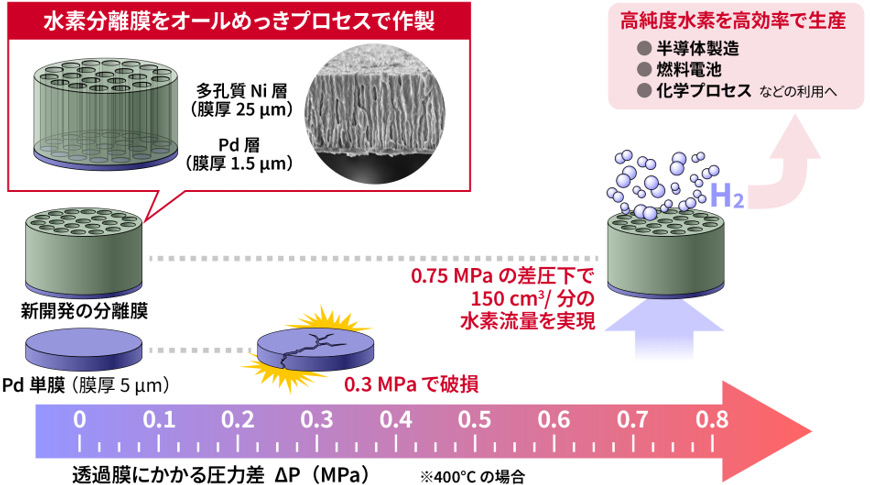
- Self-standing 1.5 μm Pd/porous Ni membranes made entirely by electroplating.
- Ni-support porosity near 30% balances gas access and mechanical reinforcement.
- H2 flow exceeds 150 cm3/min (Ø7.1 mm) at 0.75 MPa and 400 °C with no measurable He leak.
- Sustainable pressure rises from 0.3 to 0.75 MPa versus a 5 μm Pd membrane.
- Supports above 50% porosity fail at 0.5 MPa, showing an optimum porosity.
Abstract
Ultrathin Pd composite membranes can reduce Pd consumption and increase hydrogen flux, but maintaining gas tightness under differential pressure remains challenging. Self-standing pure-Pd/porous Ni composite membranes are fabricated by electroplating-based reverse build-up to examine how Ni-support porosity affects permeation and pressure resistance. The membranes comprise a 1.5 μm-thick dense Pd layer and a 22–24 μm-thick porous Ni support. After hydrogen permeation at 400 °C, scanning electron microscopy (SEM), X-ray diffraction (XRD), and SEM–energy-dispersive X-ray spectroscopy (SEM-EDS) show no significant Pd/Ni interfacial delamination or clear evidence of Pd–Ni alloying or large-scale interdiffusion within analytical resolution and sensitivity. The membrane with approximately 30% Ni-support porosity remains gas-tight, delivering hydrogen flow exceeding 150 cm3 min−1 through a Ø7.1 mm membrane at 0.75 MPa differential pressure, whereas membranes above 50% porosity develop localized pinholes at 0.5 MPa. Porosity-controlled Ni supports balance gas pathways and mechanical reinforcement, enabling Pd membranes with reduced Pd use and enhanced pressure resistance.