2026-10-30 中国科学院(CAS)
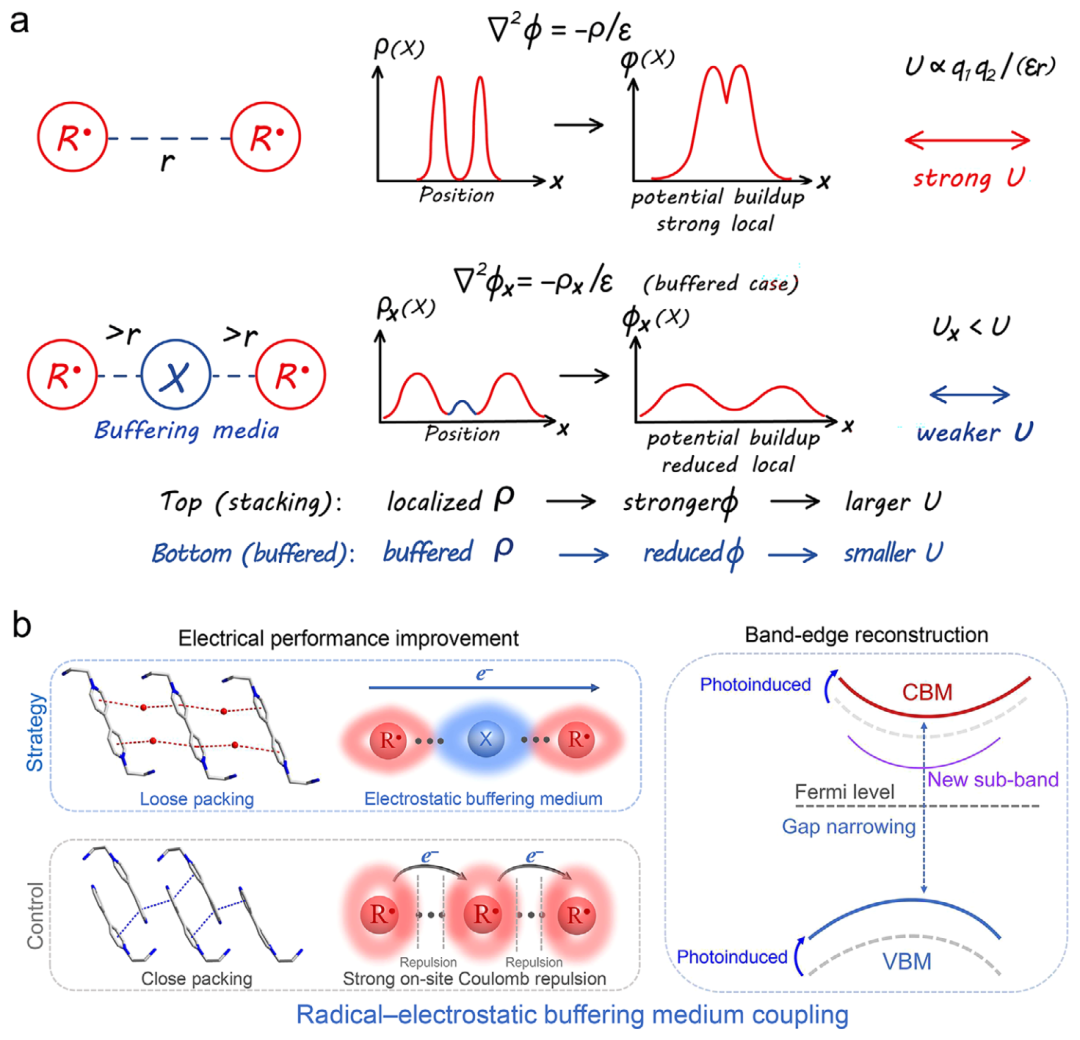
Illustration of the research (Image by Prof. LIN and Prof. GUO’s group)
<関連情報>
- https://english.cas.cn/newsroom/research-news/202610/t20261030_1212929.shtml
- https://onlinelibrary.wiley.com/doi/abs/10.1002/anie.8462867
静電的に緩衝されたラジカルカップリングによるハイブリッドペロブスカイトにおける有機サブ格子の電子機能の活性化 Activating Electronic Functionality of Organic Sublattices in Hybrid Perovskites Through Electrostatically Buffered Radical Coupling
De-Lin Hu, Wen-Yan Xu, Fei-ping Lai, Shu-Juan Lin, Guo-Cong Guo
Angewandte Chemie International Edition Published: 24 October 2026
DOI:https://doi.org/10.1002/anie.8462867
Abstract
Organic–inorganic hybrid perovskites have emerged as important optoelectronic semiconductors, yet their chemically versatile organic sublattices remain largely electronically inactive. In this study, we introduce electrostatically buffered radical coupling (EBRC) as an alternative electronic-coupling mode for activating organic sublattices. By inserting an electrostatic buffering medium between neighboring organic radicals, EBRC alleviates the intrinsic limitation of direct radical π-stacking, where strong Coulombic repulsion within partially filled radical bands promotes Mott–Hubbard-type localization. Using photochromic viologen-based hybrid perovskites as model systems, we directly compare EBRC with conventional compact radical π-stacking. Counterintuitively, despite the larger intermolecular separation and reduced orbital overlap, the EBRC system exhibits an approximately 100-fold enhancement in conductivity and photocurrent, whereas the compact radical π-stacked counterpart shows only negligible improvement. The EBRC system further increases carrier mobility by approximately 70-fold, facilitates efficient organic–inorganic electron transport, and enables light-induced reversible reconstruction of the band-edge electronic structure. These findings establish electrostatic buffering as a complementary design principle for engineering intermolecular electronic coupling beyond the conventional orbital-overlap paradigm, providing a general framework for activating electronically functional organic sublattices in perovskites and related radical semiconductors.