2026-09-22 スタンフォード大学
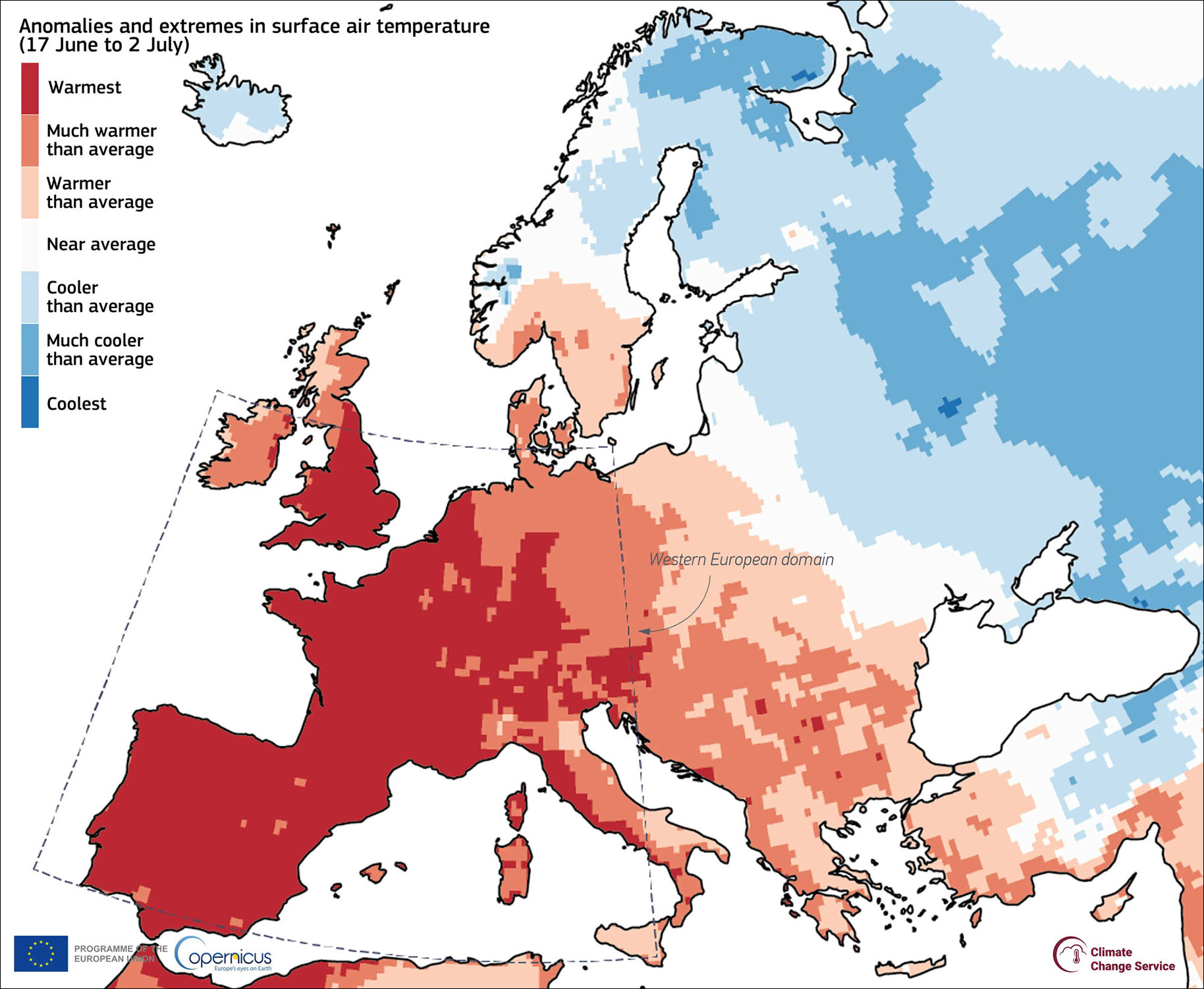
A heat wave swept western and southern Europe from June 17 to July 2, 2025. The event’s average air temperatures are compared here to the same 16-day period from 1979 to 2024. Red indicates that the 2025 heat event had the warmest average temperature of any year since 1979. | European Union, Copernicus Climate Change Service Data
<関連情報>
- https://news.stanford.edu/stories/2026/09/emissions-europe-heat-waves
- https://agupubs.onlinelibrary.wiley.com/doi/10.1029/2026GL125079
パリ協定以降の世界的な排出量増加が、近年のヨーロッパの熱波を激化させている Global Emissions Since the Paris Agreement Have Intensified Europe’s Recent Heatwaves
Jared T. Trok, Elizabeth A. Barnes, Emily M. Gordon, Frances V. Davenport, Noah S. Diffenbaugh
Geophysical Research Letters Published: 22 September 2026
DOI:https://doi.org/10.1029/2026GL125079
Abstract
Understanding the consequences of continued greenhouse-gas emissions requires determining whether recent emissions can be robustly linked to changes in extreme weather events. However, current approaches have a limited ability to quantify changes in extreme weather caused by small subsets of anthropogenic emissions, particularly for individual events. To address these limitations, we train a generative machine-learning model to predict spatially-explicit changes in daily surface temperature at different levels of cumulative emissions, conditional on the event’s observed meteorological conditions. Using this approach, we find strong evidence (>95% probability) that the combined effects of anthropogenic emissions released since the 2015 UN Paris Agreement have increased the intensity of Europe’s summer temperature extremes since 2021. Additionally, our results suggest >99% probability that regional-mean temperature during Europe’s high-impact June 2025 heatwave would have been lower (median estimate of 0.34°C) if the same large-scale meteorological conditions had occurred under 2015 levels of cumulative emissions.