2026-09-24 カナダ・コンコルディア大学
<関連情報>
- https://www.concordia.ca/cunews/artsci/2026/09/24/research-climate-overshoot-will-leave-lasting-impacts-even-after-global-temperatures-fall.html
- https://www.nature.com/articles/s43247-026-03761-z
気温のオーバーシュート(積算温度年数)によって引き起こされる不可逆的な気候変動 Irreversible climate changes driven by degree-years of temperature overshoot
Mitchell Dickau, Kirsten Zickfeld & H. Damon Matthews
Communications Earth & Environment Published:16 June 2026
DOI:https://doi.org/10.1038/s43247-026-03761-z Early provide
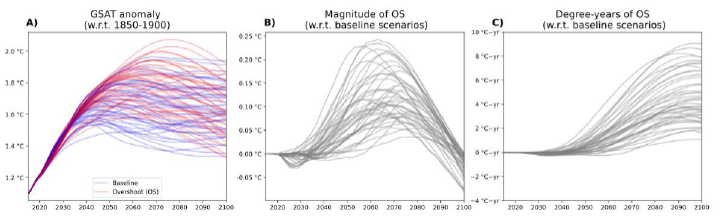
Figure 1 – Global surface air temperature (GSAT) changes, overshoot magnitude, and degree-years of OS across
the ensemble. Paired OS and baseline scenarios used in this study which achieve a long-term temperature target of
less than 2°C with peak temperatures in the OS scenarios ranging from 1.5 to 2.0°C. Panel (A) shows average
global surface air temperature (GSAT) anomaly in OS (red lines) and their paired baseline (blue lines) scenarios
with respect to 1850-1900. Panel (B) shows the magnitude of OS relative to the paired baseline scenarios. Panel (C)
shows the degree-years of OS (i.e., the time integrated difference in temperature change between an OS and baseline
scenario pair).
Abstract
It is becoming increasingly likely that meeting the long-term temperature goal of the Paris Agreement will involve a period of temperature overshoot. Understanding the effect of overshoot on climate outcomes requires an assessment of the reversibility of climate changes caused by overshooting global temperature levels. Here, using an intermediate-complexity Earth system model, we quantify the short-term reversibility of a suite of climate variables across an ensemble of 42 pairs of overshoot and baseline scenarios. For highly irreversible climate variables like permafrost and ocean changes, we show that the outcome of overshoot is linearly related to the time-integrated overshoot magnitude, which we define here as the degree-years of temperature overshoot. Our results show that degree-years of overshoot can be used to predict the changes of a range of irreversible ocean and permafrost variables in overshoot scenarios relative to a baseline scenario, therefore offering important insights into the risks of overshooting climate targets.