2026-09-08 国立天文台
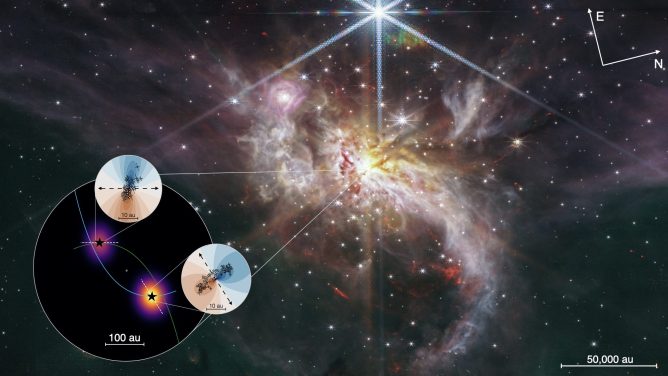
図1:円内は、アルマ望遠鏡により波長0.9mmの連続波で観測された、星形成領域IRAS 07299−1651中心部にある連星系。(クレジット:NASA, ESA, CSA, STScI, Joseph DePasquale (STScI), ALMA (ESO/NAOJ/NRAO), Yichen Zhang)
<関連情報>
- https://alma-telescope.jp/news/mbassemble-202609.html
- https://www.nature.com/articles/s41550-026-02953-z
中心核合体放物線衝突によって形成された、風変わりな巨大プロトバイナリー An eccentric massive protobinary assembled via a core-merger parabolic encounter
Yao Wang,Yichen Zhang,Rubén Fedriani,Kei E. I. Tanaka,Viviana Rosero,Kai Yang,Morten Andersen,Maria T. Beltrán,Mélisse Bonfand,Yu Cheng,James M. De Buizer,Yihuan Di,Guido Garay,Prasanta Gorai,Zhi-Yun Li,Yao-Lun Yang & Jonathan C. Tan
Nature Astronomy Published:07 September 2026
DOI:https://doi.org/10.1038/s41550-026-02953-z
Abstract
Most massive stars form in binary systems, which profoundly influence their subsequent evolution. However, how such systems form remains poorly understood, with several competing scenarios proposed, including disk fragmentation, core fragmentation and capture. Determining the orbital architectures of massive binaries, particularly during their earliest embedded phases, is, therefore, crucial for distinguishing among these formation pathways, but direct measurements of their three-dimensional motions have remained exceptionally challenging. Here we present high-resolution, multi-epoch submillimetre-to-centimetre ALMA and JVLA observations of the massive protobinary IRAS 07299−1651, complemented by JWST and VLT infrared imaging. We detect the orbital proper motion of the binary components, enabling a full three-dimensional orbital reconstruction. Combining orbital fitting, multi-wavelength continuum modelling, hydrogen recombination line kinematics and jet observations, we find that the preferred orbital solutions are highly eccentric and close to parabolic, and both circumstellar disks are strongly misaligned with the orbital plane. These properties are naturally explained by a ‘core-merger’ scenario in which the two protostars originated independently from initially unbound cores that recently underwent a near-parabolic encounter, producing an eccentric binary with a current separation of about 200 au. These findings suggest that the core-merger process may represent an important pathway for forming eccentric massive binaries.