2026-09-08 東京大学
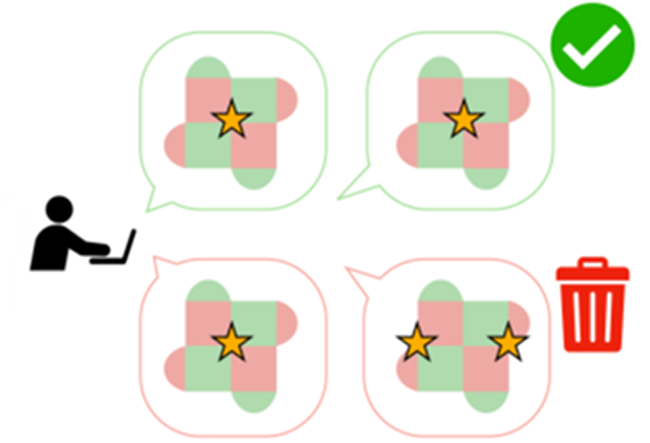
手法のイメージ図
<関連情報>
- https://www.icepp.s.u-tokyo.ac.jp/information/20260909.html
- https://journals.aps.org/prl/abstract/10.1103/sv11-f78l
qLDPC符号のためのシンプルで効率的かつ汎用的な事後選択復号法 Simple, Efficient, and Generic Postselection Decoding for qLDPC Codes
Haipeng Xie, Nobuyuki Yoshioka, Kento Tsubouchi, and Ying Li
Physical Review Letters Published: 8 September, 2026
DOI: https://doi.org/10.1103/sv11-f78l
Abstract
Quantum error correction is indispensable for scalable quantum computation. Although encoding logical qubits substantially enhances noise resilience, achieving logical error rates low enough for practical algorithms remains challenging on existing hardware. Here, we introduce argument reweighting, a simple and broadly applicable postselection decoding strategy that boosts the performance of maximum-likelihood-type decoders, including minimum-weight perfect matching and belief-propagation families. The method suppresses logical errors by performing additional decoding rounds under reweighted error models, enabling acceptance of high-confidence syndrome outcomes. Circuit-level simulations across multiple decoders and qLDPC codes show that argument reweighting substantially suppresses logical errors, requiring a rejection rate of only 1.44 ×10⁻⁵ to reduce the logical error rate by almost 2 orders of magnitude for the [[144,12,12]] bivariate bicycle code. These results establish argument reweighting as a practical and resource-efficient approach for enhancing quantum fault tolerance.