2026-09-09 早稲田大学
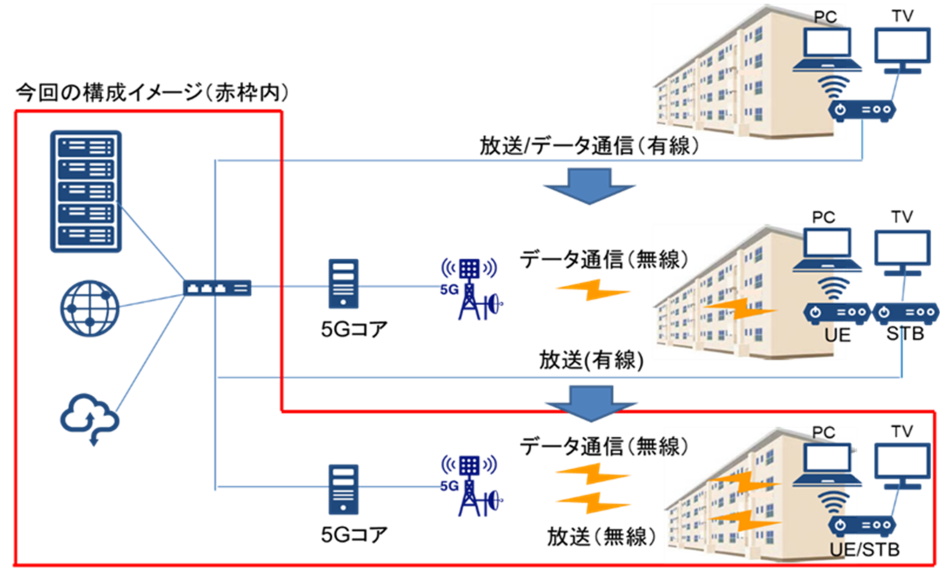
図1: ラストワンマイルにローカル5Gを用いたケーブルテレビへの移行イメージ
<関連情報>
5Gマルチキャスト・ブロードキャストサービス(MBS)向けのトランスフォーマーに基づくMCS予測 Transformer-Based MCS Prediction for 5G Multicast-Broadcast Services (MBS)
Kasidis Arunruangsirilert and Jiro Katto
The 2026 IEEE 104th Vehicular Technology Conference
発表日(現地時間):2026年9月8日14時(米国東部夏時間)
arXiv Submitted on 16 May 2026
DOI:https://doi.org/10.48550/arXiv.2605.16735
Abstract
The deployment of 5G Multicast-Broadcast Services (MBS) is emerging as a critical technology for spectral-efficient UHD content delivery and serving as a promising solution to modernize CATV deployment. However, unlike unicast networks that rely on RLC-AM with HARQ retransmissions, MBS broadcast operates in RLC Unacknowledged Mode (RLC-UM), where the absence of a feedback loop means packet loss is permanent and immediately impacts user QoE. Conventional link adaptation algorithms, designed for unicast, typically aggressively maximize throughput and fail in this risk-intolerant environment, resulting in severe video stalls and rebuffering. To address this, we propose a lightweight Transformer-based framework that predicts the success probability of all 28 MCS indices over an upcoming video segment horizon. Utilizing a unique commercial network dataset with 0.5 ms slot-level granularity, we train our model using a custom Asymmetric Safety Loss function that penalizes channel overestimation to prioritize link stability. Experimental results show that our approach achieves a reliability score of 86.89%, significantly outperforming standard AI baselines optimized for raw throughput (31.65%) while maintaining a safe conservative bias. Furthermore, the model is optimized for real-time applications, demonstrating an inference time of less than 0.07 ms on COTS 5G-era smartphones.