2026-08-26 中国科学院(CAS)
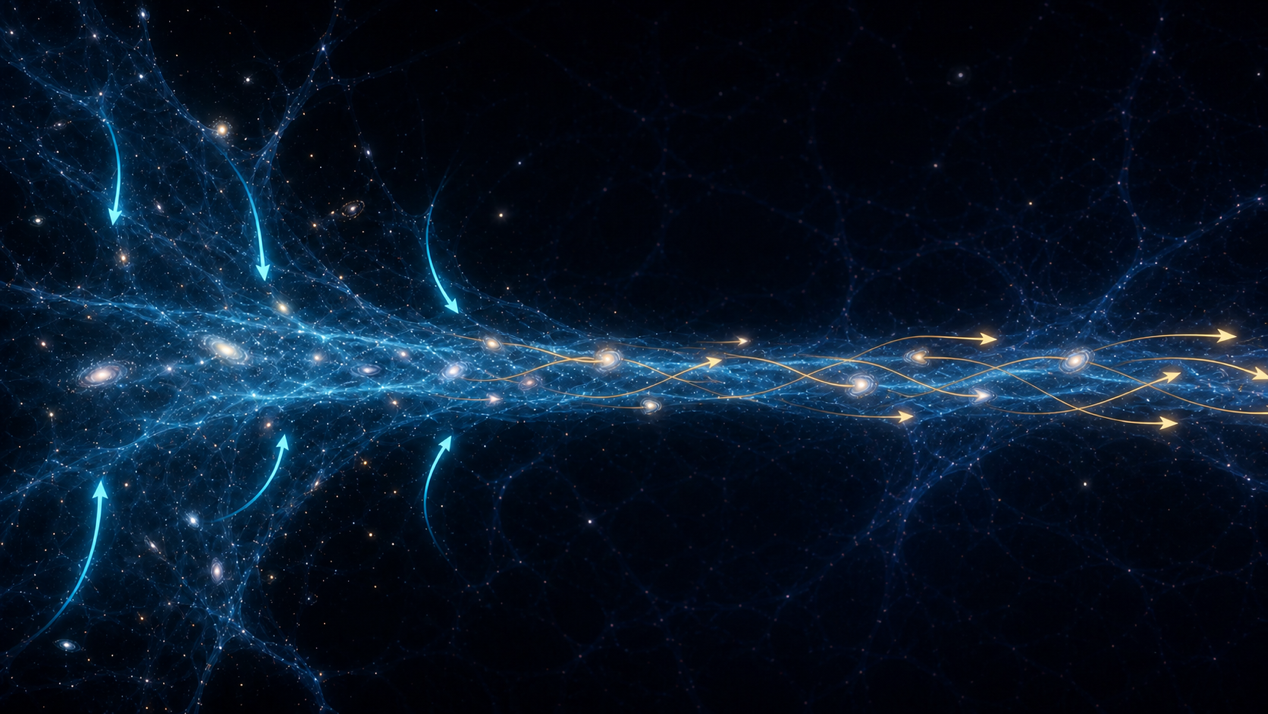
Two-stage accretion around a cosmic filament. Matter and galaxies first flow from the surrounding environment, including cosmic walls, into the filament in directions approximately perpendicular to its axis. Once inside the filament, satellite galaxies are transported toward galaxy groups or clusters through longitudinal and helical motions along the filament axis. Blue arrows indicate lateral infall, while golden arrows indicate transport along the filament. (Image by SHAO)
<関連情報>
- https://english.cas.cn/newsroom/research-news/202608/t20260826_1188943.shtml
- https://iopscience.iop.org/article/10.3847/2041-8213/ae9935
衛星の軌道姿勢から得られる宇宙フィラメントの運動学的記憶の観測的証拠 Observational Evidence for the Kinematic Memory of Cosmic Filaments from Satellite Orbital Orientations
Peng Wang (王鹏), Wei Wang (王伟), Wenting Wang (王文婷), Min Bao (鲍敏), Xi Kang (康熙), Hong Guo (郭宏), Youcai Zhang (张友财), and Xiao-xiao Tang (唐潇潇)
The Astrophysical Journal Letters Published: 2026 August 24
DOI:10.3847/2041-8213/ae9935
Abstract
We present an observational study of the kinematic coherence between satellite orbital planes and the cosmic web. Using the SDSS DR12 galaxy sample combined with the Bisous filament catalogue, we investigate whether the orbital motion of satellites preserves the memory of filamentary accretion. For each satellite system, we define a projected orbital-normal vector using galaxy sky positions and line-of-sight velocity offsets. By measuring the angle θ between this vector and the local projected filament direction, we detect a distinctive preferred orientation: satellite orbital planes tend to contain or lie parallel to the filament axis. This signal deviates from the isotropic expectation at a high significance level of 12.8σ. The strength of this kinematic connection depend strongly on environment and host properties. The preference for orbital planes to track the filament direction is most pronounced for groups in close distance to the filament spine and for more massive hosts. Conversely, at intermediate distances from the filament and at large group-centric radii, the signal reverses, indicating a tendency for orbital planes to be oriented perpendicular to the filament. Our findings provide direct observational evidence for the two-phase model of filamentary accretion, where a transition from initial perpendicular collapse toward the filament spine to subsequent parallel streamwise infall into dark matter haloes governs the orientation of satellite orbital angular momentum and galaxy spin. The observed transition may further trace the characteristic radial scale of filaments, offering a dynamical perspective on the internal structure and assembly of the cosmic filament.