2026-08-28 名古屋大学
<関連情報>
- https://www.nagoya-u.ac.jp/researchinfo/result/2026/08/post-1061.html
- https://onlinelibrary.wiley.com/doi/10.1002/anie.9296585
X字型キラル非フラーレンn型半導体:ペロブスカイト太陽電池への応用とキラリティ誘起スピン選択性 An X‑Shaped Chiral Non‑Fullerene n-Type Semiconductor: Application in Perovskite Solar Cells and Chirality‑Induced Spin Selectivity
Yuki Sakamoto, Koki Otsuka, Kuraudo Ishihara, Shuang Li, Ai Shimazaki, Megumi Haramatsu, Junichiro Hirano, Juntaro Nogami, Hiroshi Shinokubo, Hiroki Uratani ,…
Angewandte Chemie International Edition Published: 26 August 2026
DOI:https://doi.org/10.1002/anie.9296585
ABSTRACT
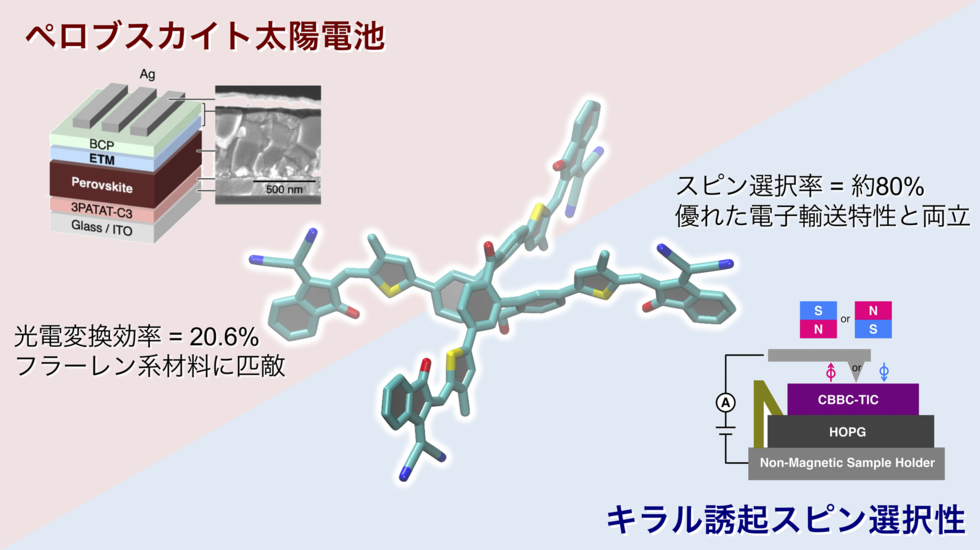
The development of a new building block for creating solution-processable amorphous n-type semiconductors provides a platform of fundamental importance for advanced organic electronic materials. We have recently demonstrated that oxidative inner‑bond cleavage of readily available dibenzo[g,p]chrysene affords a chiral figure‑eight macrocycle that bears electron‑withdrawing carbonyl groups, namely cyclobisbiphenylenecarbonyl (CBBC). In this study, we report a highly electron‑accepting derivative of CBBC (CBBC‑TIC), in which the CBBC core is connected to four electron‑withdrawing dicyanomethylene‑3‑indanone (IC) units via thiophene spacers. The distinctive X‑shaped molecular structure of CBBC‑TIC enables the solution-process fabrication of a homogeneous amorphous film with good electron conductivity. Perovskite solar cells that contain CBBC‑TIC as the electron-transport layer achieved a power conversion efficiency of 20.6%, which is comparable to that obtained with the benchmark fullerene derivative [6,6]-phenyl-C61-butyric acid methyl ester (PCBM). Furthermore, the enantiomers of CBBC-TIC exhibited spin-selective electron transport arising from the chirality-induced spin-selectivity (CISS) effect, with remarkably high enantiospecific magnetic conductance asymmetry values of up to 80% in amorphous films. These findings demonstrate that CBBC represents a versatile molecular component for the creation of advanced non‑fullerene n-type semiconductors.