
2026-07-15 中国科学院(CAS)
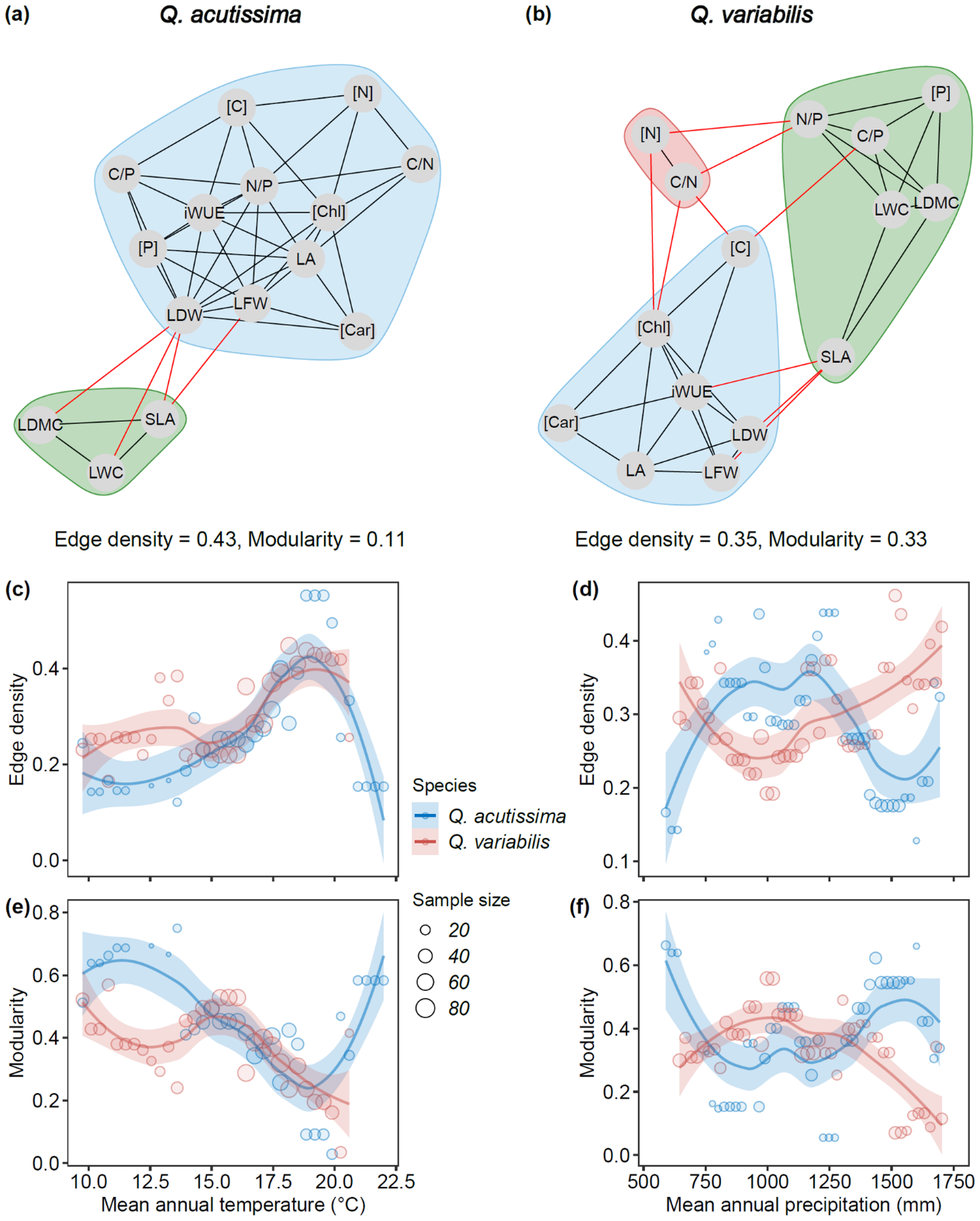
Plant trait networks of Quercus acutissima and Q. variabilis, and variation in edge density and modularity of plant trait network along climate gradients. (Image by LAI Yuan)
<関連情報>
- https://english.cas.cn/newsroom/research-news/202607/t20260715_1178423.shtml
- https://onlinelibrary.wiley.com/doi/10.1111/pce.70742
同所的に生育するオークは、気候勾配に沿って適応戦略において局所的な分岐と収束を示す Sympatric Oaks Exhibit Local Divergence and Convergence in Adaptive Strategies Along Climate Gradients
Yuan Lai, Yutong Lin, Songbo Tang, Jordi Sardans, Josep Peñuelas, Canyue Sun, Jianfeng Liu, Yuanwen Kuang
Plant, Cell & Environment Published: 09 July 2026
DOI:https://doi.org/10.1111/pce.70742
ABSTRACT
The coexistence mechanisms of wide-ranging species across climate gradients are crucial for predicting their geographic range shift and community assembly. Two coexisting oaks (Quercus acutissima and Quercus variabilis) were sampled from broad-leaved forests across China. Fifteen plant functional traits related to morphology, physiology and stoichiometry were determined to assess the interspecific and intraspecific variability, trait integration and ecological strategies. Nine among the 15 studied functional traits differed significantly between the two oaks. Given all the studied traits, the two oaks exhibited similar intraspecific variability (29.0 vs. 27.9), but diverged trait-level variability, with Q. acutissima showing 13.1% lower morphological but 11.4% higher physiological variability than Q. variabilis. The connectivity and complexity within trait correlation networks of the two oaks covaried across favourable temperature ranges (ca. 15°C–20°C), but diverged below 15°C and above 20°C and along precipitation gradients. Both the oaks were clustered around competitive and stress-tolerant ecological strategies within their sampling ranges; however, Q. variabilis were more competitive but less stress-tolerant than Q. acutissima when growing at their distribution edges. Our results imply local divergent and convergent adaptation of the sympatric oaks via altering trait-level plasticity and trait integration along climate gradients, potentially leading to greater niche differentiation and complex community assembly.

