
2026-05-28 カリフォルニア大学リバーサイド校(UCR)
<関連情報>
- https://news.ucr.edu/articles/2026/05/28/megafire-kills-joshua-trees-not-fungi
- https://link.springer.com/article/10.1186/s42408-025-00435-7
- https://enviromicro-journals.onlinelibrary.wiley.com/doi/10.1111/1462-2920.70138
モハベ砂漠の微生物群集は、ドーム火災後の広範囲にわたる植物の枯死にもかかわらず、3年間にわたり高い抵抗力と回復力を示した Mojave Desert microbial communities show high resistance and resilience over three years despite widespread plant mortality following the Dome Fire
Arik Joukhajian,M. Fabiola Pulido Barriga,Melanie J. Davis,Lynn C. Sweet & Sydney I. Glassman
Fire Ecology Published:16 January 2026
DOI:https://doi.org/10.1186/s42408-025-00435-7
Abstract
Background
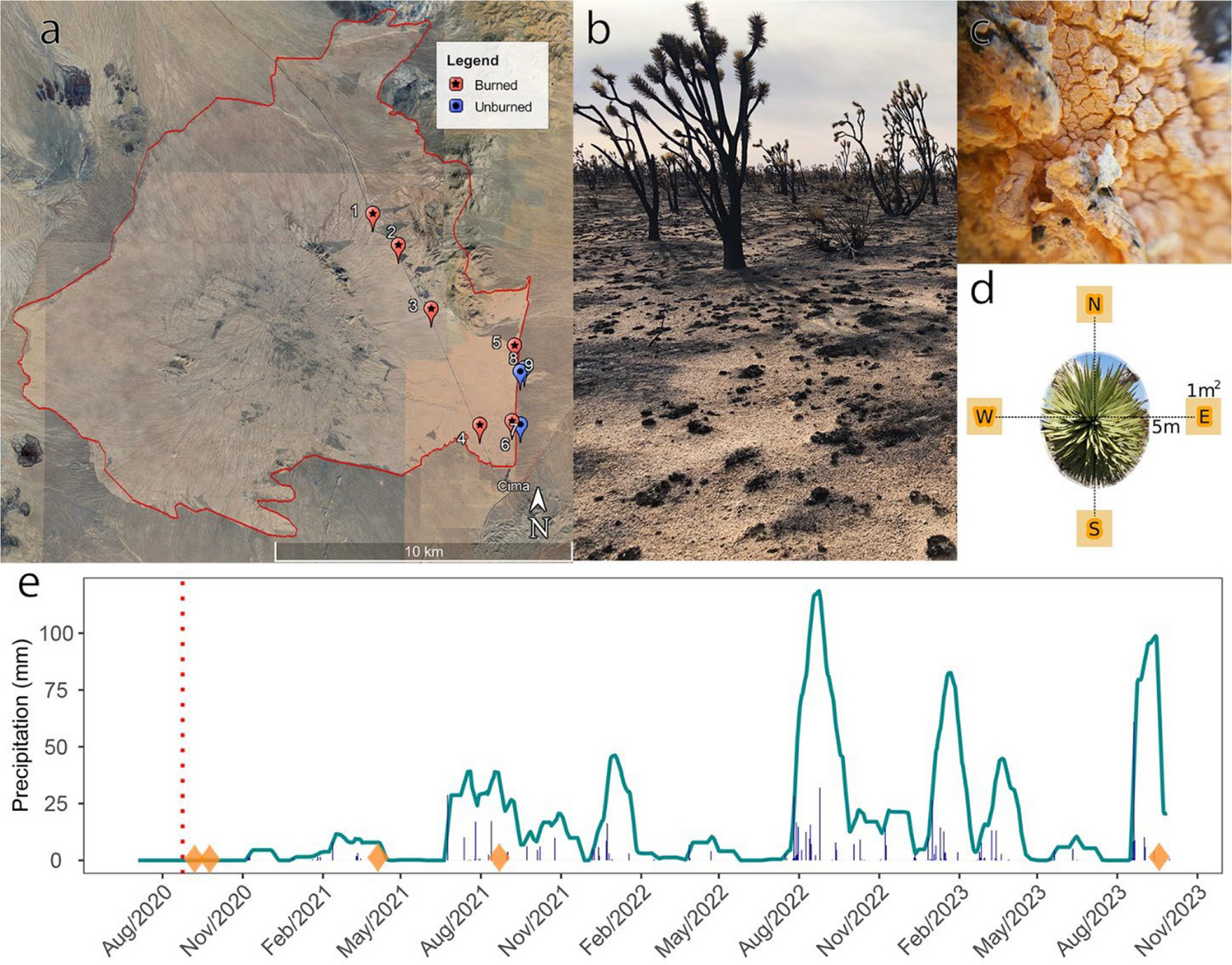
High severity desert fires are uncommon but typically chart a new successional trajectory altering plant communities for at least 65 years. These aboveground vegetation shifts can have large implications for belowground microbial communities that maintain soil structure and nutrient cycling. High severity wildfires in forests or shrublands can severely reduce microbial species richness and biomass and alter microbiomes for decades but impacts on desert soil microbiomes are virtually unknown. The 2020 Mojave Desert Dome Fire burned 43,273 acres of Eastern Joshua tree (Yucca jaegeriana) habitat, burning roughly 1 million trees. To track aboveground and belowground impacts of the Dome Fire, we established 9 plots (6 burned; 3 unburned) and sampled 4 subsamples per plot for 5 time points ranging from 2 weeks to 3 years post-fire. We measured initial ash depth as a proxy of soil burn severity and assessed plant mortality, plant richness, soil chemical characteristics, estimated soil microbial biomass with qPCR, and microbial richness and composition with Illumina MiSeq of 16S and ITS2 amplicons.
Results
Belowground communities were highly diverse, containing 25,444 bacterial, 269 archaeal, and 6,683 fungal ASVs amplicon sequence variants (ASVs) or microbial taxa. We identified at least 65 plant species and saw 80% Eastern Joshua tree mortality in burned plots over three years, with reduced plant richness post-fire except an abundance of annual herbs at 1-year post-fire, yet the fire did not significantly reduce microbial biomass or richness at any time point. Microbial communities for both bacteria and fungi showed small but significant changes, enriching for pyrophilous microbes in burned plots. We identified increases of pyrophilous microbes such as Tumebacillus, Massilia, Noviherbaspirillum bacteria and Pseudotricharina, Penicillium, Coniochaeta and Naganishia fungi.
Conclusions
We present the first comprehensive above and belowground examination following a natural desert wildfire including Archaea, Bacteria, and Fungi. Despite the widespread mortality of Eastern Joshua trees across 3 years, microbial biomass, richness, and community composition were mostly resistant to change, like microbial responses to low-intensity fast-moving grassland fires. Despite high resistance overall, wildfire still increased several pyrophilous bacterial and fungal taxa common after high severity shrubland and forest wildfires.
東部ジョシュアツリーのアーバスキュラー菌根菌は、根、土壌、季節を問わずほぼ一貫している Eastern Joshua Tree Arbuscular Mycorrhizal Fungi Largely Consistent Across Roots, Soils, and Seasons
Arik Joukhajian, Sydney I. Glassman
Environmental Microbiology Published: 07 July 2025
DOI:https://doi.org/10.1111/1462-2920.70138
ABSTRACT
The Mojave Desert is home to iconic Joshua trees threatened by climate change. Most desert plants form mutually beneficial partnerships with arbuscular mycorrhizal fungi (AMF), yet the AMF of the Eastern Joshua tree (Yucca jaegeriana) remain completely uncharacterized. We tested how Y. jaegeriana AMF spore abundance, richness, and composition varied when sampling 20 trees across 4 seasons from roots versus soils. We confirmed root colonisation via staining, assessed spore abundance via microscopy, and used Illumina MiSeq to sequence AMF virtual taxa (VT) with WANDA AML2 primers. We identified 12 spore morphotypes and 47 VTs across 5 families within Glomeromycotina, and the most abundant VT, Glomus VTX00294, appeared in 87% of soil and root samples. The majority of VTs (26/47) were present across all seasons and were shared among soil and roots (38/47), with more VTs unique to soil. In soil, per tree mean spore abundance and AMF richness were lowest in Summer but consistent across other seasons, with richness ranging from 8.8 to 11.5 VTs and mean root richness consistent across seasons. We conclude that sampling from soils rather than roots and any season other than Summer will yield the most diverse AMF communities.

