2026-07-02 中国科学院(CAS)
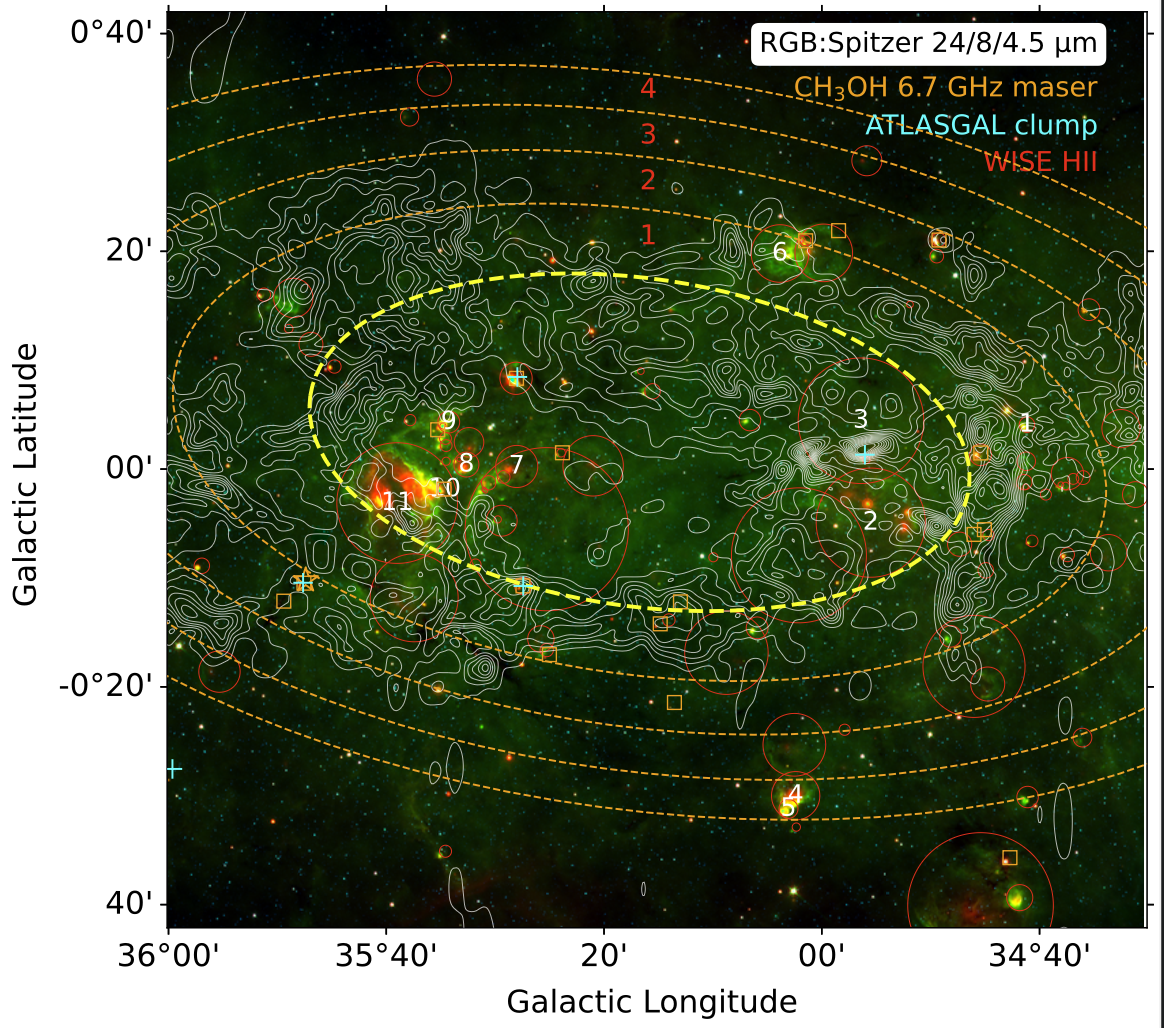
Multiwavelength view of the ring-like molecular structure G35.28+0.04. (Image by XAO)
<関連情報>
- https://english.cas.cn/newsroom/research-news/202607/t20260702_1175344.shtml
- https://academic.oup.com/mnras/article/549/4/stag1030/8700652?login=false
膨張する環状構造G35.28+0.04に関連した複数時代にわたる星形成 Multi-epoch star formation associated with the expanding ring-like structure G35.28+0.04
Mingke Sun,Jarken Esimbek,Christian Henkel,Jianjun Zhou,Gang Wu,Yuxin He,Xinyu Yang,Dalei Li,Xindi Tang,Toktarkhan Komesh,…
Monthly Notices of the Royal Astronomical Society Published:03 June 2026
DOI:https://doi.org/10.1093/mnras/stag1030
ABSTRACT
We present a study of the expanding molecular ring G35.28+0.04. Based on 6.7 GHz methanol maser data, we determine its distance to be 8.85+1.15-0.91 kpc. Using CO ( J = 1–0) observations from the Purple Mountain Observatory 13.7 m telescope together with multiwavelength archival data, we investigate the kinematic properties of the ring and its potential role in multigeneration star formation. The molecular gas shows clear expansion signatures, and the probability density function of NH2 exhibits a typical double lognormal distribution, consistent with turbulence and feedback-driven compression. H ii regions inside and outside the ring show a bimodal age distribution, which is suggestive of sequential or hierarchical star formation, with younger regions potentially associated with later stages of feedback. Spectral energy distribution fitting of point sources reveals no clear age gradient among young stellar objects. Class III sources are radially concentrated toward regions of strong molecular compression; however, these sources may largely trace an earlier stellar population or the ambient field rather than being directly produced by the current expansion of the ring. Infrared and radio continuum data further indicate that the ionizing feedback from the original exciting source has significantly weakened, although the ring structure still preserves dynamical imprints of its long-term evolution. Taken together, our results are consistent with a scenario in which G35.28+0.04 has experienced feedback-influenced, possibly multigenerational star formation over the past∼21–28 Myr, providing new insight into the evolution of molecular rings and hierarchical star formation processes.