2026-06-25 合肥物質科学研究院(HFIPS)
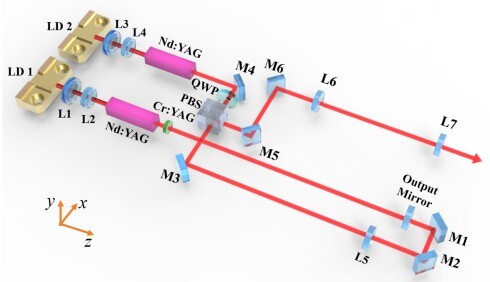
Fig. 1. Experimental setup of the MOPA laser system (Image by CHEN Jinxin)
<関連情報>
- https://english.hf.cas.cn/nr/rn/202606/t20260625_1174793.html
- https://opg.optica.org/oe/fulltext.cfm?uri=oe-34-12-21174
風速ライダー用デュアルシングルエミッタダイオード励起パッシブQスイッチNd:YAG MOPAレーザー Dual single-emitter diode-pumped passively Q-switched Nd:YAG MOPA laser for wind lidar
Jinxin Chen, Yuyang Wang, Xi Chen, Gang Cheng, Yajun Wu, Xiaonan Zhao, Huihui Gao, Linhao Shang, Pan Liu, Yibin Fu, Guangqiang Fan, Tianshu Zhang, Xinhui Sun, and Wenqing Liu
Optics Express Published: June 1, 2026
DOI:https://doi.org/10.1364/OE.597328
Abstract
High-resolution wind field sensing in the near-surface layer (up to several hundred meters) is increasingly critical to emerging paradigms such as the low-altitude economy, wind energy optimization, and aviation safety. While traditional Doppler wind lidars are highly accurate, their reliance on complex frequency-shift demodulation and strict optical aberration control limits their cost-effectiveness and environmental adaptability in widespread, near-surface deployments. To address these bottlenecks, this study develops a compact, passively Q-switched Nd:YAG master oscillator power amplifier (MOPA) laser for non-Doppler direct-detection wind lidar. Utilizing a single-diode pump, a two-stage temperature control design, and polarization-coupled double-pass amplification, the laser achieves a highly stable output at a 3.96 kHz repetition rate, with a single-pulse energy of 442.9 µJ, a pulse width of 5.012 ns, and near-diffraction-limited beam quality (M2X=1.62,MX=1.60 ). Notably, the system exhibits exceptional thermal robustness; operating across a harsh 30–50 °C temperature range, it maintains power stability better than ±3% and beam angular drift below 50 µrad—performance that exceeds commercial counterparts. Integrated into a multi-beam, scanner-free lidar architecture, the system successfully demonstrated continuous 24-hour wind profile measurements that closely align with those from in-situ meteorological sensors. This robust, lightweight, and cost-effective laser source represents a highly viable solution for scalable near-surface wind remote sensing in complex environments.