2026-07-31 海洋研究開発機構,Earth Sciences New Zealand,産業技術総合研究所
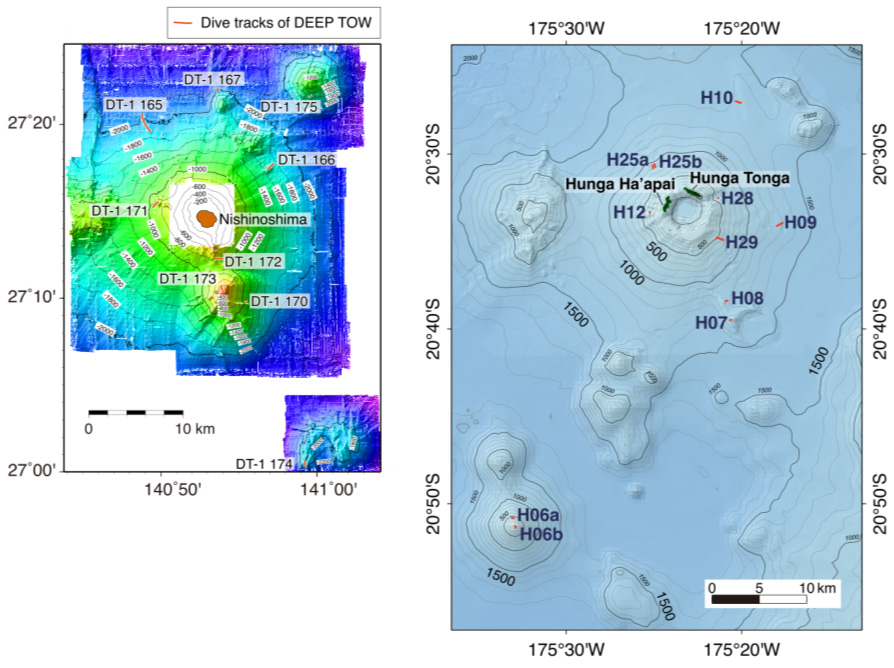
図1 西之島(左)とフンガ火山(右)の海底地形の比較
<関連情報>
- https://www.jamstec.go.jp/j/about/press_release/20260731/
- https://www.nature.com/articles/s41598-026-59118-1
トンガ弧のフンガ火山系における玄武岩質およびマグネシウム質安山岩質マグマの発見 Discovery of basaltic and magnesian andesite magmas within the Hunga volcanic system, Tonga arc
Yoshihiko Tamura,Tomoki Sato,Richard Wysoczanski,Kevin Mackay,Iona McIntosh,Qing Chang,Takashi Miyazaki,Bogdan Vaglarov & Yasuhiro Hirai
Scientific Reports Published:31 July 2026
DOI:https://doi.org/10.1038/s41598-026-59118-1
Abstract
The climactic explosive eruption of Hunga volcano in January 2022 destroyed a significant portion of the Hunga Tonga-Hunga Ha’apai islands, deepening the caldera floor by over 600 m and depositing 3.5 km3 of material onto its submarine flanks. In April–May 2022, just three months after the event, we conducted a rapid-response marine survey. Through hard-rock dredging across the submerged edifice, we recovered a comprehensive sample suite to investigate the geochemical evolution of the Hunga magma system. The dredged rocks span a compositional range from basalt to rhyolite, categorized into four groups: basalt–basaltic andesite (50.9–53.2 wt%), magnesian andesite (53.6–55.7 wt%), andesite–dacite (54.3–64.8 wt%), and rhyolite (70.8–73.2 wt%). A distinct 5 wt% gap exists between the dacites and rhyolites. While previously reported subaerial andesites largely overlap with the andesite–dacite group, our findings reveal a broader compositional diversity. These new data suggest the co-existence of both primary basaltic and primary andesitic magmas, offering new insights into the plumbing system of the 2022 eruption and similar arc volcanoes.