
2026-06-18 イリノイ大学アーバナ・シャンペーン校
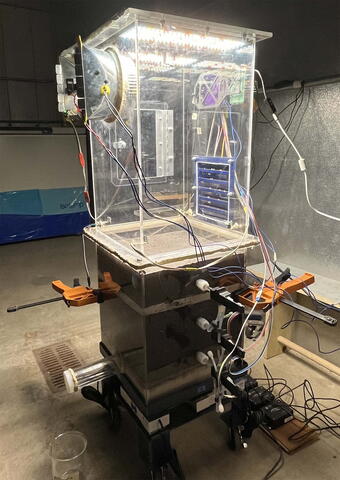
Lysimeter with soil sample
<関連情報>
- https://aces.illinois.edu/news/illinois-study-how-cracks-dry-soil-impact-moisture-evaporation
- https://www.sciencedirect.com/science/article/pii/S0167198726001522
乾燥による亀裂と裸地の蒸発への影響 Desiccation cracks and their impacts on bare soil evaporation
Kristelle Marie S. Dela Cruz, Maria L. Chu, Jorge A. Guzman
Soil and Tillage Research Available online: 13 April 2026
DOI:https://doi.org/10.1016/j.still.2026.107207
Highlights
- A lysimeter was set up to monitor desiccation soil cracks (DSC) development in bare loamy soil.
- DSC enhanced soil evaporation in Phase I but suppressed evaporation in Phases II and III.
- Hydrological markers associated with DSC propagation were identified.
- DSC accelerated the transition to Phase II by enhancing hydraulic disconnection.
- An empirical formulation was developed to account for the effects of DSC in the transport equation.
Abstract
Desiccation soil cracks (DSC) often develop in soils subjected to prolonged water loss. While extensive research has examined these cracks in relation to soil’s hydrologic function, their impact on soil evaporation (SE) remains underrepresented in scalable hydrological modeling applications, despite substantial grounds from laboratory-scale experimental evidence. This study investigates the effects of DSC in the bare SE process and identifies key hydrological markers associated with their development. A 0.3 × 0.3 × 0.3 m3 soil column was used to observe the occurrence and propagation of soil cracks. The column housed an environmental chamber with air temperature control, a digital camera, a sand-packed tile drain, tensiometers and thermometers evenly spaced vertically along the soil profile, and load cells to monitor the column’s weight changes. We exposed the column to successive cycles of wetting and drying conditions. Soil matric potential, surface ambient conditions, and soil weights were periodically recorded using sensors. At the same time, DSC propagation was analyzed through image processing techniques. Results reveal that DSC development is strongly associated with the shifts in evaporation rates across stages. While cracks enhance water loss during Phase I, they also induce a counter effect in the remaining stages, where matric potential loss inhibits capillary-driven water supply from deeper layers, thereby reducing the cumulative evaporation depth. The reduced capillarity and increased air intrusion induced by DSC result in faster desiccation in the surface and prolonged soil-water retention in deeper soil layers, intensifying the hydrologic imbalance along the soil profile. To account for these dynamics, we propose an empirical function that integrates crack effects into the estimation of the SE fluxes, providing a representation of DSC in water-availability assessments while ensuring scalability for broader applications. Ultimately, this study lays the foundation for bridging the gap between detailed experimental investigation on DSC and large-scale hydrological modeling frameworks.

